Watch the Training and Test Run Video
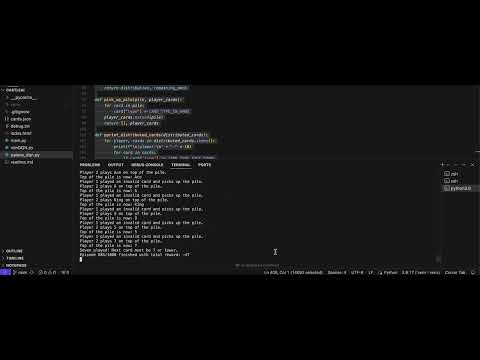
Detailed explanation of the code is available at: https://castle-ai-eight.vercel.app/
This repository contains two implementations of the Palace card game: a traditional player-vs-computer version (main.py) and an AI-powered version using Deep Q-Learning (palace_dqn.py).
Palace is a card game where players aim to get rid of all their cards by playing them onto a central pile. Each player starts with:
- 3 face-down cards (unknown)
- 3 face-up cards (visible to all)
- 3 cards in hand
A traditional implementation of the Palace card game featuring:
- Human vs Human gameplay
- Human vs Computer gameplay (with basic AI)
- Complete rule implementation including:
- Special card effects (2, 7, 10)
- Hand management
- Face-down card mechanics
- Pile pickup rules
Key Features:
- Interactive command-line interface
- Card validation and rule enforcement
- Flexible game modes
- Deck management and card distribution
- Turn-based gameplay system
An advanced implementation using Deep Q-Learning Neural Networks featuring:
- Sophisticated AI agents that learn through gameplay
- Deep Q-Network (DQN) architecture with:
- Input Layer: 91 neurons
- Hidden Layer 1: 128 neurons (ReLU)
- Hidden Layer 2: 64 neurons (ReLU)
- Output Layer: 3 neurons
Key Features:
- State representation (91-dimensional vector)
- Experience replay memory
- ε-greedy exploration strategy
- Reward system for reinforcement learning
- PyTorch implementation of neural networks
numpy pytorch
Follow the prompts to:
- Choose game mode (Human vs Human or Human vs Computer)
- Play cards by entering suit and rank
- Choose to pick up pile when necessary
This will:
- Initialize two AI agents
- Train them through 1000 episodes
- Display final test game results
-
Players must play cards of equal or higher rank than the top card
-
Special cards:
- 2: Resets pile, play again
- 7: Next player must play 7 or lower
- 10: Burns pile, play again
-
Card hierarchy:
- 2-10: Face value
- Jack: 11
- Queen: 12
- King: 13
- Ace: 14
- Joker: 15
- 15 dimensions × 3 types for Player 1
- 15 dimensions × 3 types for Player 2
- 15 dimensions for pile top card
- 1 dimension for special rules
- Learning Rate (α): 0.001
- Discount Factor (γ): 0.99
- Initial Exploration Rate (ε): 1.0
- Exploration Decay: 0.995
- Minimum Exploration: 0.01
- +10: Winning the game
- +1: Valid play
- -5: Invalid play
- -10: Picking up pile