
Architecture Principle: AI systems fail in coordination, not compute. GPUs rarely fail. The storage and network feeding them fail constantly.
This repository consolidates Rack2Cloud research on AI cluster failure modes into a structured reference for architects and infrastructure teams operating AI infrastructure at scale.
AI cluster failure has evolved beyond hardware and resource failures. In 2026, the dominant failure modes in production AI environments fall into three layers:
- Hardware and fabric failures — GPU fabric saturation, training/inference split, storage I/O constraints
- Control plane failures — single-region control plane domains, shadow AI control planes, agentic AI control plane sprawl
- Governance and authority failures — unknown agents, unauthorized model calls, unmapped attack surfaces, unbudgeted resource dimensions
This repository addresses all three layers. Teams that only design for the hardware layer will encounter control plane and governance failures at production scale.
The intended audience is AI infrastructure engineers, platform architects, and ML platform teams responsible for designing and operating AI clusters in production.
AI clusters exhibit non-linear failure patterns. Traditional availability metrics do not model distributed training reliability.
When training stalls or inference latency spikes, the root cause is almost always outside the compute nodes. The failure originates from checkpoint timing, storage IO limits, GPU desynchronization, or network jitter.
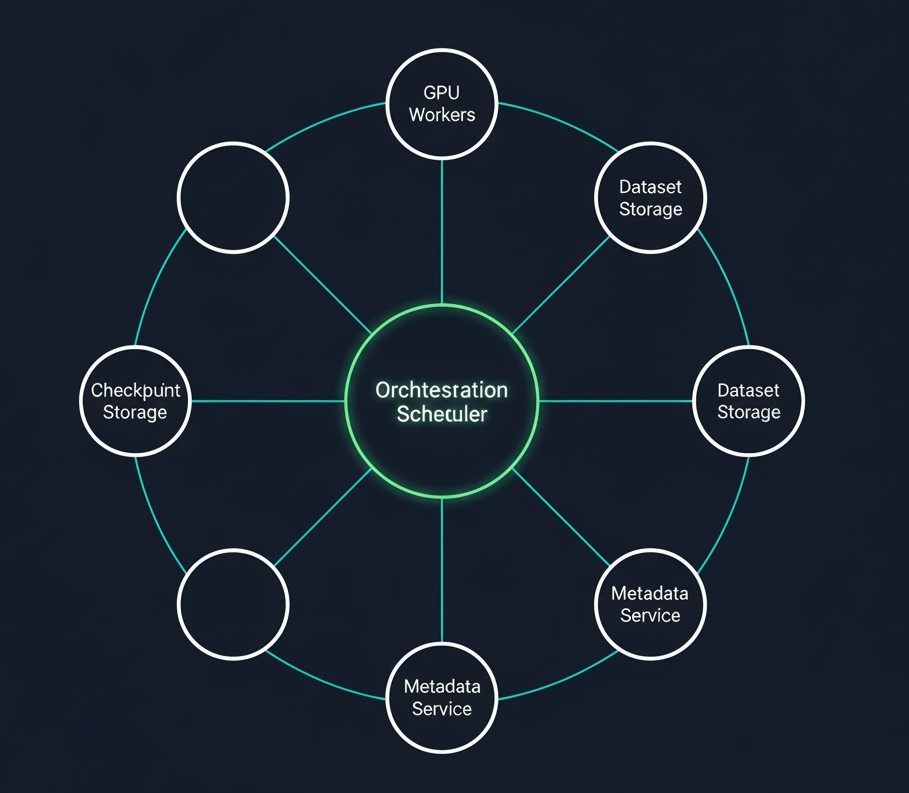
Layers of Dependency:
- Dataset Storage (Cold/Warm)
- Metadata Service
- Checkpoint Storage (Hot)
- GPU Workers
- Orchestration Scheduler
Throughput consistency is vastly more important than peak theoretical bandwidth. Here is how distributed training actually fails, and how to fix it:
| Failure Mode | Symptom / Impact | Architectural Mitigation |
|---|---|---|
| Checkpoint Stalls | GPUs drop to 0% utilization every few hours; Training pauses. | Implement parallel file systems (e.g., WEKA, Lustre) instead of standard NFS for multi-tier caching. |
| Network Jitter / Incast | Multi-node training efficiency drops; Throughput collapses. | Deploy lossless, dedicated RoCEv2 or InfiniBand fabrics with tuned Priority Flow Control (PFC). |
| Node Desync | Gradient corruption; Entire job crashes if one node fails. | Implement fault-tolerant orchestration (like Torch Distributed Elastic) to handle worker scaling without full restarts. |
| API Rate Limiting | Zombie API keys draining LLM token quotas; Inference timeouts. | Deploy an AI-specific API Gateway (Control Plane) for strict token-level throttling. |
Physical and fabric-layer failure modes that constrain AI cluster architecture.
GPU Fabric Architecture
- GPU Fabric Physics 2026: Why 800G Isn't Enough for 100k-GPU Training — Fabric saturation as a structural constraint for large-scale training clusters.
- The Training/Inference Split Is Now Hardware — What GTC 2026 Actually Changed — Hardware bifurcation between training and inference as an architectural reality.
- InfiniBand Is Losing the Fabric War. Here's What That Changes for Your Architecture. — Fabric technology transition and its architectural implications.
Storage and Compute Constraints
- The Storage Wall: ZFS vs. Ceph vs. NVMe-oF for AI Training Clusters — Storage architecture failure modes for AI training workloads.
- All-NVMe Ceph for AI: When Distributed Storage Actually Beats Local ZFS — Storage architecture tradeoffs at AI cluster scale.
- The Manual Nvidia Forgot: A Seasoned Architect's Guide to AI Training Clusters — Undocumented failure modes in H100 training cluster design.
- TPU Logic for Architects: When to Choose Accelerated Compute Over Traditional CPUs — Accelerated compute selection as an architectural decision.
GPU Utilization Failures
- Your AI Cluster Is Idle 95% of the Time — GPU utilization as a systemic cluster failure mode.
- GPU Utilization Is Becoming the New Cloud Waste Crisis — GPU waste at infrastructure scale.
- GPU Allocation Governance Is the Next AI Infrastructure Crisis — GPU governance failure as a cluster-level crisis. (Added 2026-06-30)
CPU Resource Constraints
- The CPU Is Back in the Stack — and Nobody Budgeted for It — CPU coordination overhead as an unbudgeted failure constraint for agentic AI workloads. (Added 2026-06-30)
Failures in the systems that govern, orchestrate, and operate AI clusters.
Single Points of Failure
- Most AI Control Planes Have a Single-Region Failure Domain — Control plane regional failure domain as a structural architecture risk. (Added 2026-06-30)
- The Control Plane Shift: Every Infrastructure Decision Now Looks the Same — The convergence of infrastructure decisions around control plane architecture.
- Agentic AI Has a Control Plane Problem — Because It Became the Control Plane — Agentic AI systems as unintended control planes.
Shadow and Sprawl Failures
- The AI Control Plane Is Becoming the New Shadow IT — AI control plane sprawl as an operational unknown. (Added 2026-06-30)
- Nobody Meant to Build an AI Control Plane — Tool sprawl as the mechanism of accidental control plane accumulation.
- The CLI Was Always the Control Plane. Now It's Being Handed to Machines. — CLI authority transfer as a control plane failure vector.
Inference Placement Failures
- Inference Routing Is Becoming an Infrastructure Placement Problem — Inference routing as a placement failure vector. (Added 2026-06-30)
- AI Placement Decisions Are Architecture — Not Optimization — Placement decisions as architectural constraints with failure consequences.
- AI Gravity & Placement Engine — Placement decision support tool.
Networking as AI Control Plane
- The Network Is Becoming the AI Control Plane — Network architecture as AI control plane infrastructure.
- Deterministic Networking: The Missing Layer in AI-Ready Infrastructure — Deterministic networking as a prerequisite for AI control plane reliability.
Failure modes specific to agentic AI systems — autonomous agents operating with tool access and control plane authority.
Inventory and Visibility Failures
- Nobody Knows How Many AI Agents They're Running — Agent inventory as a fundamental operational unknown in agentic AI environments. (Added 2026-06-30)
- Autonomous Systems Don't Fail. They Drift Until They Break. — Drift as the primary failure mode in autonomous AI systems.
- Autonomous Operations Require Infrastructure Most Enterprises Don't Have — Infrastructure maturity gaps that produce agentic AI failure. (Added 2026-06-30)
Authorization and Security Failures
- MCP, Tool Use, and the New Attack Surface Nobody Is Mapping — MCP and tool use as unmapped attack surfaces in agentic AI deployments. (Added 2026-06-30)
- The Model Answered. Nobody Asked Who Authorized That. — LLM authorization boundary as an operational failure mode.
- Kubernetes Is Not an LLM Security Boundary — Kubernetes security model failure under LLM workloads.
Failures in the ability to observe and govern AI system behavior.
Semantic Observability
- 200 OK is the New 500: The Death of Deterministic Observability — Semantic failures that defeat traditional observability systems.
- Inference Observability: Why You Don't See the Cost Spike Until It's Too Late — Inference observability lag as a cost and reliability failure mode.
- AI Systems Need Evidence, Not Just Observability — Evidence-based observability as a requirement for AI system governance. (Added 2026-06-30)
Governance Observability
- The AI Observability Layer Is Becoming a Governance System — Observability as a governance control plane for AI systems. (Added 2026-06-30)
- Your Monitoring Didn't Miss the Incident. It Was Never Designed to See It. — Monitoring architecture failure in AI environments.
Failures in the systems that govern AI infrastructure decisions, resource allocation, and operational authority.
Governance Architecture Failures
- Your AI Infrastructure Is Probably Solving the Wrong Problem — Governance misalignment as a structural AI infrastructure failure mode. (Added 2026-06-30)
- AI Didn't Reduce Engineering Complexity. It Moved It — Complexity displacement as a governance failure vector.
- GPU Scheduling in Kubernetes: Start Before the Scheduler — GPU scheduling governance in Kubernetes environments.
Regulatory and Compliance Failures
- The EU AI Act Enforcement Date Is an Infrastructure Problem, Not a Compliance Problem — Regulatory enforcement as an infrastructure failure deadline, not a compliance process. (Added 2026-06-30)
- From Static Guardrails to AI Policy Agents: 2026 Playbook for Cloud Security Teams — AI policy enforcement architecture.
Sovereign AI Failures
- Sovereign AI Requires a Sovereign Control Plane — Sovereignty failure modes in AI control plane architecture.
- The Sovereign AI Mandate: Why Private Data Must Stay on Private Infrastructure — Sovereign AI infrastructure requirements and failure modes.
Failure modes specific to inference infrastructure — production model serving under load.
Execution and Capacity Failures
- Your AI System Doesn't Have a Cost Problem. It Has No Runtime Limits. — Execution budget absence as a failure mode in inference systems.
- Inference Is Becoming the New Steady-State Cost Center — Inference as steady-state infrastructure with steady-state failure modes.
- AI Inference Is the New Egress: The Cost Layer Nobody Modeled — Inference cost architecture as an unmodeled failure dimension.
- Cost-Aware Model Routing in Production: Why Every Request Shouldn't Hit Your Best Model — Model routing failure modes under production load.
Edge and Distribution Failures
- The Disconnected Brain: Why Cloud-Dependent AI is an Architectural Liability — Cloud dependency as an edge AI failure mode.
- Beyond the Hyper-scaler: Why AI Inference is Moving to the Edge — Edge inference architecture and failure considerations.
Operational tools for evaluating AI cluster architecture, governance, and failure exposure:
| Tool | Purpose |
|---|---|
| AI Governance Analyzer | Governance layer assessment for AI infrastructure |
| AI Governance Assessment | Structured audit for AI governance gaps |
| AI Runtime & Governance Analyzer | Runtime governance measurement tool |
| Distributed Inference Survivability Engine | Inference survivability analysis across distributed deployments |
| AI Fabric Pressure Analyzer | Fabric saturation and pressure analysis |
| AI Inference Saturation Analyzer | Inference capacity and saturation measurement |
| GPU Utilization & AI Capacity Analyzer | GPU utilization and capacity analysis |
| AI Gravity & Placement Engine | Placement decision support and failure exposure |
| Engineering Workbench: AI Infrastructure Architecture | Structured starting point for AI infrastructure architecture programs |
The AI Architecture Path provides the structured learning context for this repository's content.
Relevant modules:
- Accelerated Compute Architecture
- Fabric Architecture
- Storage & Data Pipeline Architecture
- Runtime & Cluster Operations
- Operations & LLMOps Architecture
- Governance & Runtime Control
- System Survivability Architecture
- AI Governance Assessment — Structured governance gap assessment for AI infrastructure.
- Architecture Audit Services — Full audit service catalog.
- AI Model tuning or hyperparameter guidance
- GPU hardware benchmarking
This is an infrastructure reliability and diagnostic model.
This repository is maintained against the Rack2Cloud Canonical Architecture Specifications governance system.
If this framework improved your cluster reliability modeling or helped you identify a bottleneck, please star the repository.
Architectural frameworks maintained by Rack2Cloud