


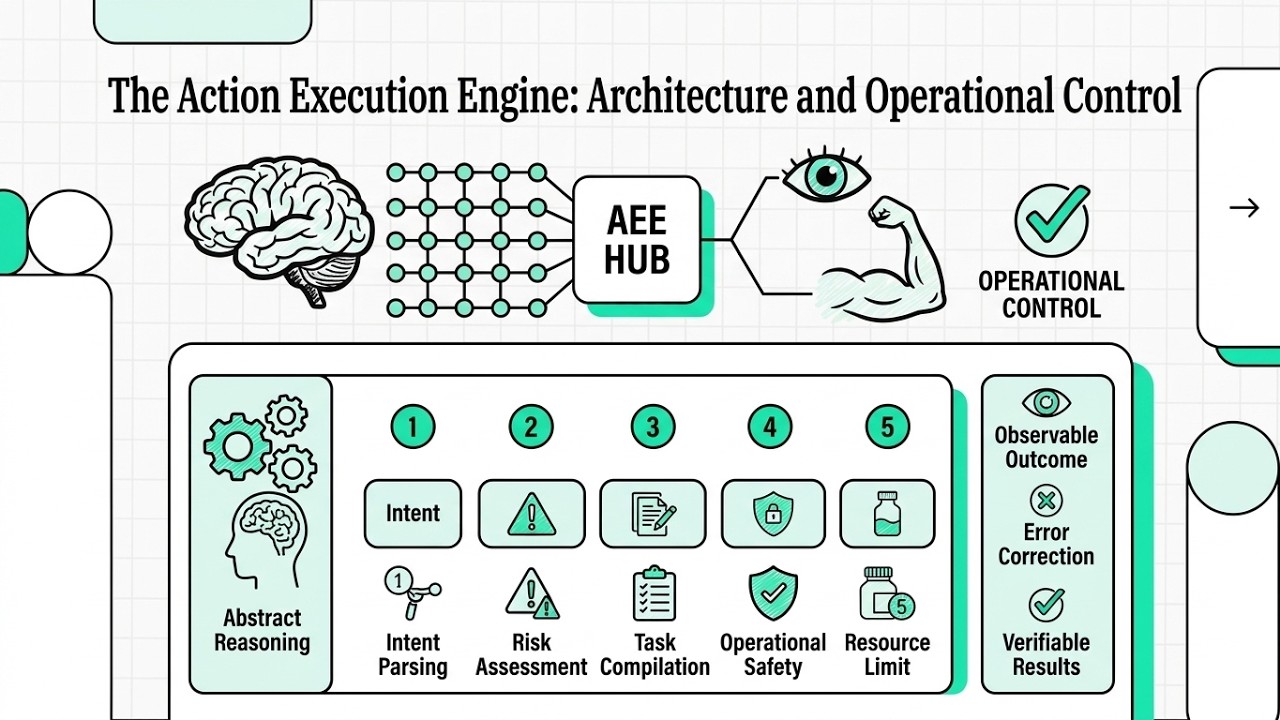
Agent Execution Partnership AEE is an open-source control plane that ensures every AI agent action is authorized before it runs, observable while it runs, and verifiable after it completes.
AI reasoning models are good at deciding what to do. They are not designed to enforce whether it should be done, who authorized it, or whether it actually worked.
The Action Execution Engine (AEE) fills that gap. It accepts a proposal from an agent, subjects it to policy evaluation, capability checks, and risk classification, executes a single bounded action through the appropriate adapter, and then verifies the outcome against the expected effects — escalating or compensating if anything goes wrong.
The reasoning model owns the intent. The AEE owns the execution contract.
- Default deny for all actions.
- Strict capability grants and resource boundaries.
- Mandatory verification after each material action.
- Human approval gates for consequential operations.
- Immutable append-only audit trail.
- Production-impact adapters disabled by default.
flowchart TD
  G[Goal] --> T[Task Contract]
  T --> O1[Observe Current State]
  O1 --> S[Select One Action Channel]
  S --> V[Validate Identity, Authority, Policy, Risk]
  V --> P[Precondition Check]
  P --> A{Approval Required?}
  A -->|Yes| H[Await Human Approval]
  A -->|No| E[Execute One Bounded Action]
  H --> E
  E --> O2[Observe Resulting State]
  O2 --> X[Verify Expected Effects]
  X --> D[Detect Unintended Effects]
  D --> N[Continue or Recover/Compensate/Pause/Cancel/Escalate]
- Create virtual environment and install:
py -m venv .venv
.\.venv\Scripts\Activate.ps1
py -m pip install -e .[dev]- Initialize database and export schemas:
aep init- Run API:
aep serve- Run tests:
pytestAutoresearch demonstrates the entire closed-loop pipeline in action. Each autonomous training experiment validates all 5 stages:
1️⃣  TASK CONTRACT: Goal = "improve validation BPB by ≥0.001"
                  Constraints: 5-min budget, 20M eval tokens, depth ≤ 12
                  Risk budget: 1 failed experiment per 10 iterations
                  Allowed tools: SGD, LoRA, learning rate sweep

2️⃣  OBSERVE STATE: Snapshot current best BPB from `results.tsv`
                  Freshness deadline: start of each 5-min window
                  Measurement: evaluate on pinned shard_06542.parquet

3️⃣  PROPOSE ACTION: "Train model with depth={D}, lr={L}"
                  Channel: training (GPU, 20+ GB VRAM required)
                  Risk class: CONSEQUENTIAL_WRITE (can evolve model)

4️⃣  POLICY EVALUATE: Validate depth ≤ 12, memory ≤ 40GB, time ≤ 300s
                    Allow: if all constraints satisfied
                    Deny: if resource limits exceeded
                    Require approval: if risk budget exhausted

5️⃣  APPROVAL GATE: Human review for unusual patterns or budget depletion
                  Auto-approve: normal variations within envelope
                  Escalate: if multiple failures detected
The training loop runs inside the control plane, executing this cycle 20+ times per session. Results are immutably logged in the audit trail.
See examples/README.md for a full walkthrough and examples/local-demo-site/README.md for the interactive demo.
PowerShell:
.\bootstrap-train.ps1Linux/macOS:
chmod +x bootstrap-train.sh
./bootstrap-train.sh
This runs the full pipeline:
- Installs training dependencies (torch, rustbpe, tiktoken, pyarrow, requests)
- Downloads 100 training shards and trains a BPE tokenizer
- Establishes baseline BPB (bits-per-byte) for the model
- Runs 20 autonomous experiments, evaluating and retaining improvements
Estimated time: ~5 min baseline + ~100 min experiments (5 min per iteration on H100 GPU).
# Install training deps
make train-install

# Download data + train tokenizer
make train-prepare

# Establish baseline BPB
make train-baseline

# Run 20 autonomous experiments
make train-run

# Or run all steps together
make train-all# Prepare data
aep research prepare --shards 100
# Run baseline
aep research train --baseline --depth 8
# Run experiments
aep research train --depth 8 --iterations 20
# Custom config
aep research train --depth 12 --iterations 50Each training run produces immutable evidence of the full closed-loop execution:
-
Experiment ledger:
research/aee-autoresearch/experiment_ledger.jsonl- Proof of pipeline: Each entry shows all 5 stages executed
- Includes: task contract (goal/constraints), policy decision (allow/deny/require), approval status, execution evidence, verification result
- Example entry:
{
  "experiment_id": "abc-def-ghi",
  "task_contract": {
    "goal": "improve_val_bpb",
    "constraints": {"time_budget_sec": 300, "depth_max": 12},
    "risk_budget": 0.1
  },
  "action_proposed": {
    "op": "train",
    "channel": "gpu_training",
    "risk_class": "CONSEQUENTIAL_WRITE"
  },
  "policy_decision": "allow",
  "approval_required": false,
  "val_bpb": 1.234,
  "decision": "retain",
  "reason": "bpb_improved_by_0.020000"
}
-
Results TSV:
research/aee-autoresearch/results.tsv- Tabular format compatible with Excel/pandas
- Columns: commit, val_bpb, memory_gb, status, description, policy_decision, approval_required
- Each row = one complete closed-loop cycle
The default model (depth=8) trains on a fixed 5-minute budget and produces ~50M parameters. Key metrics tracked:
- BPB (bits-per-byte): Lower is better; proxy for token-level prediction quality
- Memory: Peak VRAM usage in MB
- MFU: Model FLOPs utilization % (efficiency on H100)
Experiments that improve BPB by ≥0.001 are automatically retained as the new baseline.
See examples/task_contract.json.
See examples/action_request.json.
| Class | Default Control |
|---|---|
| READ_ONLY | Auto with audit |
| REVERSIBLE_WRITE | Audit and verification |
| CONSEQUENTIAL_WRITE | Verification and configurable approval |
| FINANCIAL | Explicit approval and hard limits |
| PRIVILEGED_ADMINISTRATIVE | Separation of duties |
| PHYSICAL_OR_SAFETY_RELATED | Deterministic controls and human oversight |
- Local Demo Site — Browser UI showing the 5-stage closed-loop cycle in real-time
- Simulate actions and watch policy evaluation
- Inspect audit trail entries for each stage
- Observe state snapshots and verification results
-
Examples Directory — Full training workflow showing how the control plane gates every experiment
- How task contracts specify training constraints
- How policy evaluation validates resource budgets
- How approval gates control high-risk iterations
- How audit trails prove each stage executed
-
Sample JSON Structures — Real contracts and audit logs from training runs
Interactive browser demo:
aep serve
start http://localhost:8000/demo
Run full training pipeline (demonstrates 20+ closed-loop cycles):
.\bootstrap-train.ps1Analyze the audit trail:
# Review each stage of each training experiment
python -c "import json; [print(json.dumps(x, indent=2)) for x in open('research/aee-autoresearch/experiment_ledger.jsonl')]" | head -1- Production connectors are disabled by default.
- Browser demonstration uses local safe pages.
- Infrastructure and operational adapters are simulation-first.
Early implementation. Core policy, lifecycle, audit, and adapters are available with safe defaults.
See docs/roadmap.md.
Apache License 2.0. See LICENSE and NOTICE.
Responsible disclosure process in SECURITY.md.