

AI GTM Engineer
Building automation systems that improve lead operations, connect business applications, and reduce repetitive work.




Businesses lose time when leads are processed manually, customer information is inconsistent, applications do not communicate, and workflow failures go unnoticed.
I build automation systems that address these operational problems through workflow engineering, API integrations, CRM connectivity, data processing, and AI-assisted operations.
My focus is on helping businesses:
- Capture, clean, qualify, and route incoming leads.
- Improve CRM data quality and reduce repetitive data entry.
- Connect disconnected business applications and databases.
- Automate prospect research and outbound preparation.
- Reduce repetitive administrative and operational tasks.
- Make workflow failures visible and easier to investigate.
I approach automation from the business problem first: understand the process, identify the bottleneck, design the solution, and test how it behaves when something goes wrong.
Location: Zamboanga Sibugay, Philippines (UTC+8)
Availability: Open to remote opportunities and project-based engagements.

Introduction, engineering approach, technical background, and project walkthrough.


| Category | Projects | Jump |
|---|---|---|
| Revenue Operations & CRM Automation | 4 | Explore |
| GTM Intelligence & Prospecting | 3 | Explore |
| Business Process Automation & Reliability | 3 | Explore |
| # | Project | Repository |
|---|---|---|
| 01 | Inbound Lead Sanitizer & Outreach Engine | GitHub |
| 02 | Fault-Tolerant Lead Triage Pipeline | GitHub |
| 03 | AI Lead Scoring & Priority Router | GitHub |
| 04 | Speed-to-Lead Ingestion Engine | GitHub |
| 05 | B2B Outbound Prospecting Engine | GitHub |
| 06 | Market Intelligence & B2B Lead Waterfall | GitHub |
| 07 | Native Clay Lead Waterfall | GitHub |
| 08 | AP Invoice Reconciliation Engine | GitHub |
| 09 | E-Commerce Revenue Recovery Engine | GitHub |
| 10 | Centralized n8n Error Handler | GitHub |
The portfolio is organized around concrete implementation artifacts that a reviewer can inspect.


| Evidence | What a reviewer can inspect |
|---|---|
| 10 project repositories | Individual implementation documentation and project files |
| 10 Loom demonstrations | Recorded walkthroughs of the respective projects |
| 10 workflow / architecture images | Visual evidence embedded in the project sections |
| 3 business categories | Revenue operations, GTM intelligence, and business process automation |
| Multiple integration patterns | Webhooks, APIs, CRM connections, databases, and communication tools |
| Reliability patterns | Error handling, validation, fallback logic, and human-review workflows |
Evidence standard: These are portfolio counts, not client deployment counts. They describe the artifacts presented here. They do not establish production uptime, customer ROI, revenue generated, or measured time savings.
- Repository documentation and workflow implementation.
- Workflow screenshots and architecture diagrams.
- Loom demonstration and execution walkthrough.
- Input/output examples and test scenarios, where documented.
- Error handling and limitations, where implemented.
Business focus: Improve lead capture, data quality, qualification, routing, and sales follow-up operations.
Business problem: Poor-quality inbound data creates manual cleanup work and can delay sales follow-up.

What it demonstrates
Webhook-based lead intake, phone number normalization, filtering of suspicious submissions, AI-assisted intent classification, CRM synchronization, and notifications.
Workflow architecture
Webhook Intake → E.164 Phone Normalization → Bot Filtering → Supabase/PostgreSQL Exception Handling → Gemini Intent Scoring → HubSpot Sync → Slack/WhatsApp Routing.
Technical evidence
- Phone number normalization.
- Lead filtering and data cleansing.
- AI-assisted intent scoring.
- Database-backed exception handling.
- HubSpot and communication integrations.
Business relevance: Helps improve inbound lead data quality and reduce manual preparation before sales follow-up.
Business problem: Lead-processing workflows need to account for inconsistent payloads, processing failures, and CRM update problems.
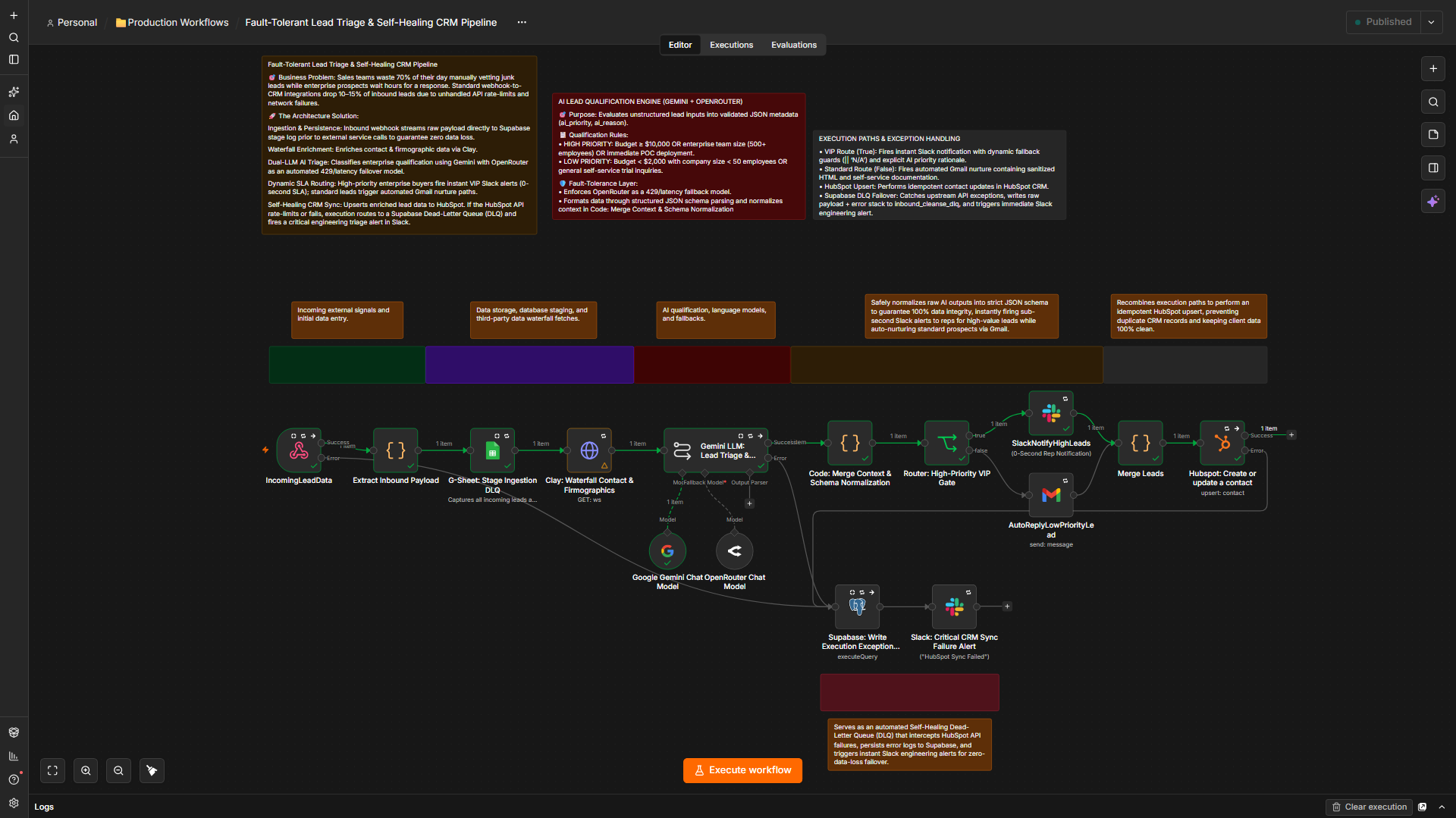
What it demonstrates
A lead-processing workflow that cleans incoming data, performs AI-assisted scoring, updates CRM records, and routes priority notifications.
Workflow architecture
Webhook Intake → Payload Sanitization & RegEx Cleansing → Gemini AI / Groq Fallback Scoring → HubSpot CRM Update → Supabase Exception Handling → Slack Priority Alert.
Technical evidence
- Webhook payload processing.
- Data sanitization.
- AI model fallback logic.
- CRM update workflow.
- Database-backed exception handling.
- Priority-based notifications.
Business relevance: Demonstrates how a sales team can organize lead processing while making workflow exceptions more visible.
Business problem: Sales teams need a consistent way to prioritize incoming inquiries instead of reviewing every lead manually.

What it demonstrates
AI-assisted lead qualification using budget, company size, and urgency signals, followed by priority-based routing.
Workflow architecture
Webhook Intake → Supabase Raw Lead Backup → Gemini Scoring + OpenRouter Fallback → Schema Validation → Multi-Tier IF Router → Slack VIP Alerts / Gmail Standard Replies → Google Sheets CRM Sync.
Technical evidence
- AI-assisted lead scoring.
- Multi-model fallback.
- Raw lead persistence.
- Structured data validation.
- Priority-based routing.
- Google Sheets and communication integrations.
Business relevance: Helps sales teams distinguish higher-priority inquiries from standard leads and organize follow-up.
Business problem: Manual lead entry and delayed internal notifications can slow down the initial response process.

What it demonstrates
Webhook-based lead capture, field normalization, Google Sheets recording, and Slack notifications.
Workflow architecture
Webhook Ingestion → Payload Normalization → Google Sheets Recording → Slack Notification.
Technical evidence
- Webhook ingestion.
- Data normalization.
- Google Sheets integration.
- Automated Slack alerts.
Business relevance: Reduces repetitive lead entry and helps the team receive incoming inquiries without waiting for manual forwarding.
Business focus: Automate company research, prospect enrichment, opportunity discovery, and outbound preparation.
Business problem: Manual prospect research and outreach preparation require repetitive information gathering and writing.

What it demonstrates
A prospecting workflow that combines company discovery, scraping, AI-assisted email drafting, human review, dispatch, and logging.
Workflow architecture
Apify Scraping → Gemini Email Drafting → Slack Human-in-the-Loop Approval → Dispatch → Logging.
Technical evidence
- Automated prospect discovery.
- AI-assisted email drafting.
- Human approval before sending.
- Outbound workflow logging.
- Controlled dispatch.
Business relevance: Reduces repetitive prospect research and drafting while keeping a human in control of outbound communication.
Business problem: Finding relevant companies and preparing usable prospect information can require several disconnected research and processing steps.

What it demonstrates
Search-based company discovery, URL verification, content processing, AI-assisted analysis, structured output validation, and human review.
Workflow architecture
SerpAPI Ingestion → URL Verification → JavaScript/RegEx Content Processing → Gemini + Groq Fallback → Zod Schema Validation → Exception Handling → Telegram Human Approval.
Technical evidence
- Search-based opportunity discovery.
- URL validation.
- JavaScript and RegEx processing.
- AI model fallback.
- Structured output validation.
- Exception handling.
- Telegram approval workflow.
Business relevance: Connects market research and prospecting preparation into a coordinated workflow.
Business problem: Prospect records may be incomplete, requiring enrichment from multiple data providers before sales teams can use them.
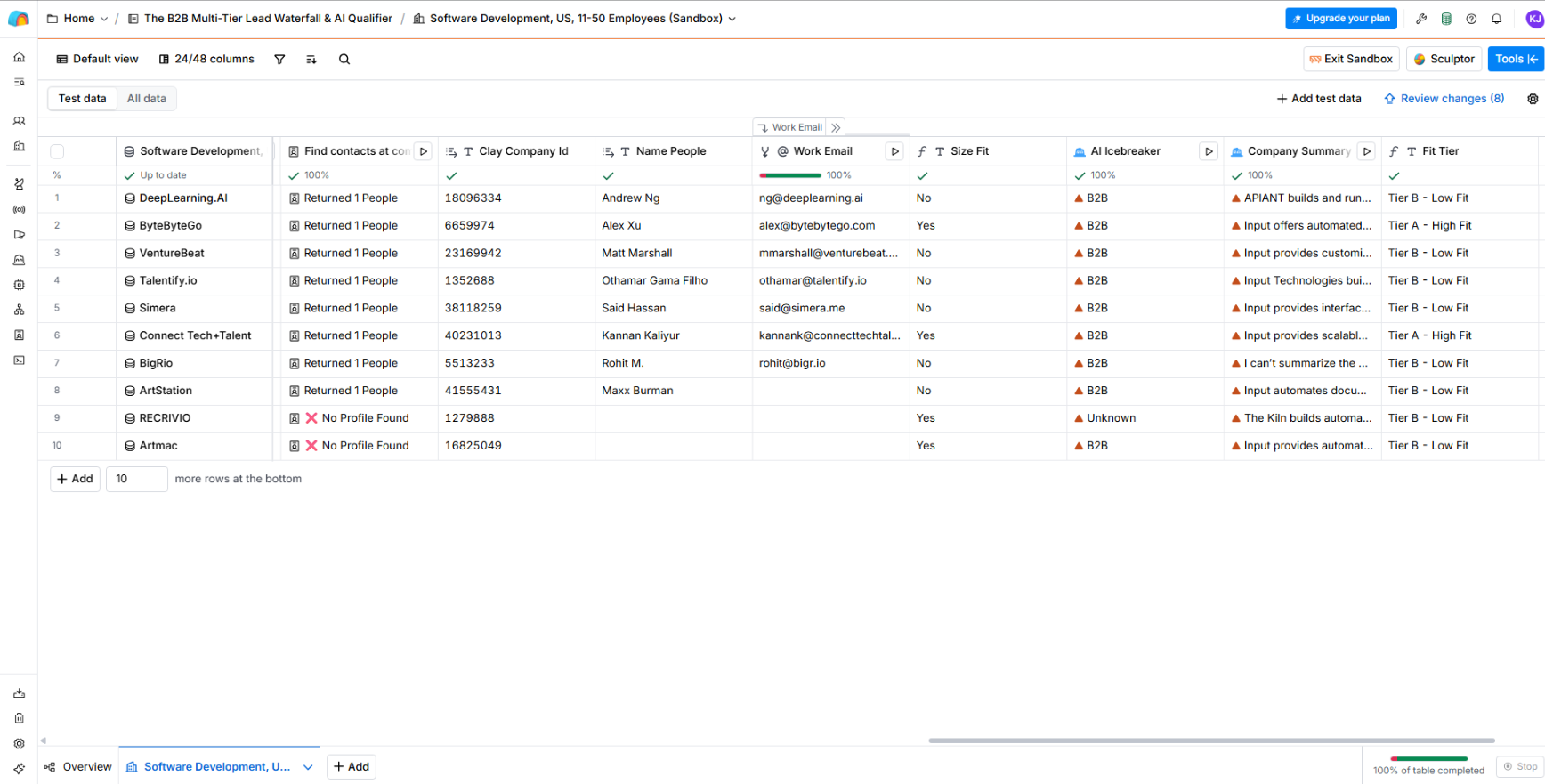
What it demonstrates
A Clay-based lead enrichment workflow using multiple provider lookups, ICP tiering, and AI-assisted outreach preparation.
Workflow architecture
Clay Native Waterfall → Multi-Provider Contact Lookup → AI ICP Fit Tiering → GTM Message Synthesis.
Technical evidence
- Multi-provider enrichment.
- Cascading lookup logic.
- ICP classification.
- AI-assisted outreach personalization.
- Tier-based lead evaluation.
Business relevance: Helps GTM teams organize prospect enrichment and prioritize contacts based on fit.
Business focus: Reduce repetitive finance and e-commerce operations while improving workflow visibility and exception handling.
Business problem: Invoice processing involves repetitive extraction, calculation checks, reconciliation, and exception review.

What it demonstrates
Invoice ingestion through Gmail and webhooks, AI-assisted document processing, mathematical verification, exception logging, approval, and accounting integration.
Workflow architecture
Gmail/Webhook Trigger → Multi-Format Document Parser → Gemini/OpenAI Fallback → Automated Math Verification → Supabase Exception Logging → Slack Human Approval → QuickBooks Online Sync.
Technical evidence
- Multi-channel invoice ingestion.
- AI-assisted document extraction.
- Line-item mathematical verification.
- Exception logging and review.
- Human approval before sensitive accounting actions.
- QuickBooks Online integration.
Business relevance: Reduces repetitive invoice-processing work and introduces structured checks and exception review into accounts payable workflows.
Business problem: Incomplete purchases can require timely follow-up, but sending unnecessary reminders to customers who already purchased creates a poor experience.

What it demonstrates
An e-commerce recovery workflow using stateful delays, purchase-status verification, AI-assisted email generation, and Gmail dispatch.
Workflow architecture
Make Scenario → Webhook Ingestion → Stateful Delay Gates → Supabase Purchase Evaluation → Gemini Email Generation → Gmail Dispatch.
Technical evidence
- Stateful workflow delays.
- Purchase-status verification.
- Conditional follow-up logic.
- AI-assisted email generation.
- Gmail integration.
Business relevance: Supports automated recovery follow-up while checking purchase status before sending another message.
Business problem: Workflow failures can go unnoticed or become difficult to investigate when execution information is scattered.

What it demonstrates
Centralized execution failure capture, diagnostic logging, notifications, and direct links to failed executions.
Workflow architecture
Centralized n8n Error Handler → Google Sheets Audit Logs → Gmail/Slack Alerts → Execution Debug Links.
Technical evidence
- Centralized error handling.
- Execution failure capture.
- Diagnostic audit trails.
- Automated notifications.
- Direct execution debugging links.
Business relevance: Improves visibility into automation failures and gives operators a clearer path to investigating incidents.
The following matrix connects the technologies and engineering patterns in my portfolio to specific projects.
| Technology / Pattern | Where It Appears |
|---|---|
| n8n | Projects 1, 3–8, 10 |
| Make | Project 9 |
| Clay | Project 7 |
| Apify | Project 5 |
| SerpAPI | Project 6 |
| HubSpot | Projects 1, 2 |
| QuickBooks Online | Project 8 |
| Supabase / PostgreSQL | Projects 1, 2, 3, 6, 8, 9 |
| Google Gemini | Projects 1–3, 5, 6, 8, 9 |
| Groq | Projects 2, 6 |
| OpenAI | Project 8 |
| OpenRouter | Project 3 |
| Zod / Structured Validation | Project 6 |
| JavaScript / RegEx | Projects 2, 6 |
| REST APIs / Webhooks | Projects 1–6, 8, 9 |
| Slack / Gmail | Projects 1–5, 8–10 |
| Telegram / WhatsApp | Projects 1, 6 |
The matrix identifies technologies represented in the project descriptions and repositories. The exact implementation, configuration, and depth of use should be verified against each project's source files and documentation.
| Pattern | Purpose |
|---|---|
| Input validation | Catch malformed or incomplete data before downstream processing |
| Data normalization | Standardize records before using them in other systems |
| Error handling | Capture and report workflow failures |
| Fallback logic | Provide alternative processing paths when a service fails |
| Exception logging | Preserve information for investigation |
| Human-in-the-loop | Require review before selected sensitive actions |
| Idempotency | Prevent duplicate processing where correctly implemented and tested |
| Dead-letter queue patterns | Isolate failed records for investigation or recovery |
An automation workflow should be designed for the conditions in which it can fail, not only the conditions in which it succeeds.
My engineering priorities:
- Understand the process first. Identify the actual business bottleneck before choosing a tool.
- Protect data integrity. Validate and normalize information before downstream processing.
- Design for failure. External APIs, services, and workflows can fail.
- Keep humans involved where necessary. Important decisions should have appropriate approval controls.
- Make workflows observable. Errors should be visible, traceable, and actionable.
- Verify before claiming. Implementation and test evidence matter more than impressive terminology.
June 2026 – Present
Developing and documenting automation systems focused on revenue operations, business process automation, AI integration, and workflow reliability.
Practical work represented in the portfolio
- Built and documented 10 independent automation projects.
- Developed lead capture, qualification, scoring, and routing workflows.
- Integrated business applications through APIs and webhooks.
- Implemented AI-assisted classification, enrichment, and information processing.
- Worked with database-backed workflows and exception handling.
- Developed human-review steps for outbound communication and financial exceptions.
- Created centralized error handling and execution-notification workflows.
- Documented projects through GitHub repositories, workflow images, and Loom demonstrations.
These are independent portfolio projects and engineering demonstrations, not a claim of 10 paid client deployments.
- Bachelor of Science in Criminology — Dr. Aurelio Mendoza Memorial College, March 2026.
- Career Service Professional Eligibility — Civil Service Commission, Philippines.
- Make Academy Advanced Certification — 2026.
- AI Automation Learning & Practical Projects — n8n and Generative AI Systems Integration, 2026.
I believe the best automation starts with understanding the business process, not choosing a tool.
| Stage | Focus |
|---|---|
| 1. Discovery | Understand the existing business process, tools, and operational bottlenecks. |
| 2. Process Analysis | Identify repetitive work, data problems, and failure points. |
| 3. System Design | Define workflow logic, data requirements, and integration architecture. |
| 4. Development | Build and test a practical end-to-end solution. |
| 5. Reliability | Add appropriate validation, exception handling, monitoring, and human approval. |
| 6. Handover | Document the workflow and explain how to operate and maintain it. |
Engagement: Remote-first · Project-based · Contract opportunities · International collaboration
- Location: Zamboanga Sibugay, Philippines (PHT, UTC+8).
- Working style: Remote-first and asynchronous communication with scheduled overlap.
- Engagement: Project-based pilots, contract work, and longer-term collaboration.
- Payment platforms: Familiar with international payment services such as Wise, Payoneer, and Deel.
Interested in improving lead operations, connecting business applications, or reducing repetitive manual processes?
I'd be glad to discuss the operational problem and explore whether automation is an appropriate solution.
Email: kchanchan2357@gmail.com
Location: Philippines (UTC+8)
Business-first thinking. Engineering-driven execution. Evidence over claims.