




This dbt package transforms data from Fivetran's Pinterest Ads connector into analytics-ready tables.
- Number of materialized models¹: 34
- Connector documentation
- dbt package documentation
This package enables you to better understand the performance of your ads across varying grains and materialize output models designed to work simultaneously with our multi-platform Ad Reporting package. It creates enriched models with metrics focused on advertiser, campaign, ad group, keyword, pin, and utm level reports.
Final output tables are generated in the following target schema:
<your_database>.<connector/schema_name>_pinterest
By default, this package materializes the following final tables:
| Table | Description |
|---|---|
pinterest_ads__ad_group_report |
Represents daily performance aggregated at the ad group level, including spend, clicks, impressions, and conversions.Example Analytics Questions:
|
pinterest_ads__advertiser_report |
Represents daily performance aggregated at the advertiser level (equivalent to account level), including spend, clicks, impressions, and conversions.Example Analytics Questions:
|
pinterest_ads__campaign_report |
Represents daily performance aggregated at the campaign level, including spend, clicks, impressions, and conversions.Example Analytics Questions:
|
pinterest_ads__campaign_country_report |
Represents daily performance aggregated at the campaign level by country, including spend, clicks, impressions, and conversions, enriched with geographic context.Example Analytics Questions:
|
pinterest_ads__campaign_region_report |
Represents daily performance aggregated at the campaign level by region, including spend, clicks, impressions, and conversions, enriched with geographic context.Example Analytics Questions:
|
pinterest_ads__keyword_report |
Represents daily performance at the individual keyword level, including spend, clicks, impressions, and conversions.Example Analytics Questions:
|
pinterest_ads__pin_promotion_report |
Represents daily performance at the individual pin promotion level (equivalent to ads in other platforms), including spend, clicks, impressions, and conversions.Example Analytics Questions:
|
pinterest_ads__url_report |
Represents daily performance at the individual URL level, including spend, clicks, impressions, and conversions, enriched with pin promotion context.Example Analytics Questions:
|
¹ Each Quickstart transformation job run materializes these models if all components of this data model are enabled. This count includes all staging, intermediate, and final models materialized as view, table, or incremental.
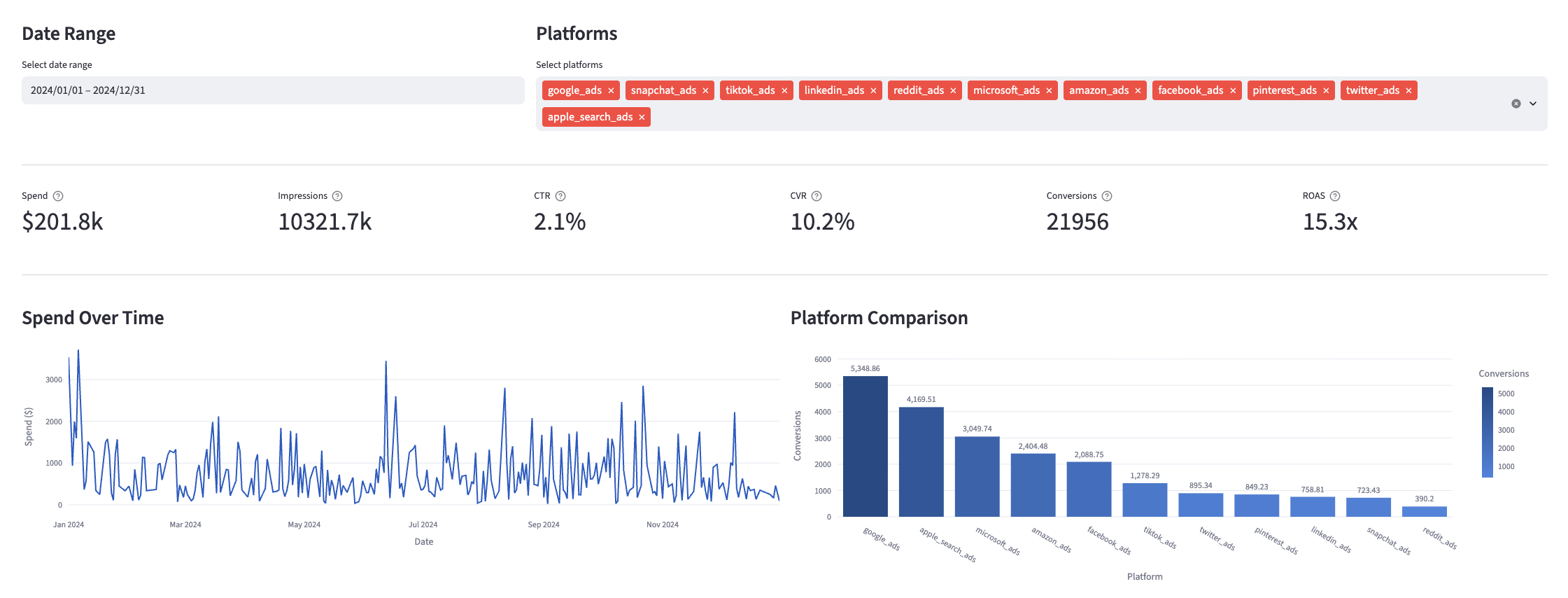
Many of the above reports are now configurable for visualization via Streamlit. Check out some sample reports here.
To use this dbt package, you must have the following:
- At least one Fivetran Pinterest Ads connection syncing data into your destination.
- A BigQuery, Snowflake, Redshift, PostgreSQL, or Databricks destination.
You can either add this dbt package in the Fivetran dashboard or import it into your dbt project:
- To add the package in the Fivetran dashboard, follow our Quickstart guide.
- To add the package to your dbt project, follow the setup instructions in the dbt package's README file to use this package.
Include the following pinterest_ads package version in your packages.yml file if you are not also using the upstream Ad Reporting combination package:
packages:
  - package: fivetran/pinterest
    version: [">=1.2.0", "<1.3.0"] # we recommend using ranges to capture non-breaking changes automatically
All required sources and staging models are now bundled into this transformation package. Do not include
fivetran/pinterest_ads_sourcein yourpackages.ymlsince this package has been deprecated.
If you are using a Databricks destination with this package you will need to add the below (or a variation of the below) dispatch configuration within your dbt_project.yml. This is required in order for the package to accurately search for macros within the dbt-labs/spark_utils then the dbt-labs/dbt_utils packages respectively.
dispatch:
  - macro_namespace: dbt_utils
search_order: ['spark_utils', 'dbt_utils']By default, this package runs using your destination and the pinterest schema. If this is not where your Pinterest Ads data is (for example, if your Pinterest Ads schema is named pinterest_fivetran), add the following configuration to your root dbt_project.yml file:
vars:
    pinterest_database: your_destination_name
pinterest_schema: your_schema_name This package takes into consideration that not every Pinterest account tracks keyword performance, and allows you to disable the corresponding functionality by adding the following variable configuration:
vars:
    pinterest__using_keywords: False # Default = true
Additionally, your Pinterest Ads connection may not sync every table that this package expects. If you do not have the PIN_PROMOTION_TARGETING_REPORT, TARGETING_GEO, or TARGETING_GEO_REGION tables synced, add the following variable to your root dbt_project.yml file:
vars:
    pinterest__using_pin_promotion_targeting_report: false # Default is true. Will disable `pinterest_ads__campaign_country_report` and `pinterest_ads__campaign_region_report` if false
    pinterest__using_targeting_geo: false # Default is true. Will disable `pinterest_ads__campaign_country_report` if false
pinterest__using_targeting_geo_region: false # Default is true. Will disable `pinterest_ads__campaign_region_report` if falseExpand/Collapse details
If you have multiple pinterest connections in Fivetran and would like to use this package on all of them simultaneously, we have provided functionality to do so. The package will union all of the data together and pass the unioned table into the transformations. You will be able to see which source it came from in the source_relation column of each model. To use this functionality, you will need to set either the pinterest_ads_union_schemas OR pinterest_ads_union_databases variables (cannot do both) in your root dbt_project.yml file:
vars:
    pinterest_ads_union_schemas: ['pinterest_usa','pinterest_canada'] # use this if the data is in different schemas/datasets of the same database/project
    pinterest_ads_union_databases: ['pinterest_usa','pinterest_canada'] # use this if the data is in different databases/projects but uses the same schema name
NOTE: The native
src_pinterest_ads.ymlconnection set up in the package will not function when the union schema/database feature is utilized. Although the data will be correctly combined, you will not observe the sources linked to the package models in the Directed Acyclic Graph (DAG). This happens because the package includes only one definedsrc_pinterest_ads.yml.
To connect your multiple schema/database sources to the package models, follow the steps outlined in the Union Data Defined Sources Configuration section of the Fivetran Utils documentation for the union_data macro. This will ensure a proper configuration and correct visualization of connections in the DAG.
By default, this package will select clicks, impressions, spend (converted from spend_in_micro_dollar), total_conversions, total_conversions_quantity, and total_conversions_value (converted from total_conversions_value_in_micro_dollar) from the source reporting tables to store into the staging models. If you would like to pass through additional metrics to the staging models, add the below configurations to your dbt_project.yml file. These variables allow for the pass-through fields to be aliased (alias) if desired, but not required. Use the below format for declaring the respective pass-through variables:
IMPORTANT: Make sure to exercise due diligence when adding metrics to these models. The metrics added by default (clicks, impressions, spend, total conversions, total conversions quantity, and total conversions value) have been vetted by the Fivetran team maintaining this package for accuracy. There are metrics included within the source reports, for example metric averages, which may be inaccurately represented at the grain for reports created in this package. You will want to ensure whichever metrics you pass through are indeed appropriate to aggregate at the respective reporting levels provided in this package.
vars:
    pinterest__ad_group_report_passthrough_metrics:
      - name: "this_field"
    pinterest__advertiser_report_passthrough_metrics:
      - name: "unique_string_field"
        alias: "field_id"
    pinterest__campaign_report_passthrough_metrics:
      - name: "that_field"
    pinterest__keyword_report_passthrough_metrics:
      - name: "other_id"
        alias: "another_id"
    pinterest__pin_promotion_report_passthrough_metrics:
      - name: "new_custom_field"
        alias: "custom_field"
    pinterest__pin_promotion_targeting_report_passthrough_metrics:
- name: "new_field"By default, this package builds the Pinterest Ads staging models (10 views, 10 models) within a schema titled (<target_schema> + _pinterest_source) and your Pinterest Ads modeling models (6 tables) within a schema titled (<target_schema> + _pinterest) in your destination. If this is not where you would like your Pinterest Ads data to be written to, add the following configuration to your root dbt_project.yml file:
models:
    pinterest:
      +schema: my_new_schema_name # Leave +schema: blank to use the default target_schema.
      staging:
+schema: my_new_schema_name # Leave +schema: blank to use the default target_schema.If an individual source table has a different name than the package expects, add the table name as it appears in your destination to the respective variable. This is not available when running the package on multiple unioned connections.
IMPORTANT: See this project's
dbt_project.ymlvariable declarations to see the expected names.
vars:
pinterest_<default_source_table_name>_identifier: your_table_name Expand for more details
Fivetran offers the ability for you to orchestrate your dbt project through Fivetran Transformations for dbt Core™. Learn how to set up your project for orchestration through Fivetran in our Transformations for dbt Core setup guides.
This dbt package is dependent on the following dbt packages. These dependencies are installed by default within this package. For more information on the following packages, refer to the dbt hub site.
IMPORTANT: If you have any of these dependent packages in your own
packages.ymlfile, we highly recommend that you remove them from your rootpackages.ymlto avoid package version conflicts.
packages:
    - package: fivetran/fivetran_utils
      version: [">=0.4.0", "<0.5.0"]

    - package: dbt-labs/dbt_utils
      version: [">=1.0.0", "<2.0.0"]

    - package: dbt-labs/spark_utils
version: [">=0.3.0", "<0.4.0"]The Fivetran team maintaining this package only maintains the latest version of the package. We highly recommend you stay consistent with the latest version of the package and refer to the CHANGELOG and release notes for more information on changes across versions.
A small team of analytics engineers at Fivetran develops these dbt packages. However, the packages are made better by community contributions.
We highly encourage and welcome contributions to this package. Learn how to contribute to a package in dbt's Contributing to an external dbt package article.
In creating this package, which is meant for a wide range of use cases, we had to take opinionated stances on a few different questions we came across during development. We've consolidated significant choices we made in the DECISIONLOG.md, and will continue to update as the package evolves. We are always open to and encourage feedback on these choices, and the package in general.
We thank everyone who has taken the time to contribute. Each PR, bug report, and feature request has made this package better and is truly appreciated.
A special thank you to Seer Interactive, who we closely collaborated with to introduce native conversion support to our Ad packages.
- If you have questions or want to reach out for help, see the GitHub Issue section to find the right avenue of support for you.
- If you would like to provide feedback to the dbt package team at Fivetran or would like to request a new dbt package, fill out our Feedback Form.