A composite GitHub Action that turns conventional commits into a draft release PR, tags the PR on merge, and stages publishing to npm via OIDC trusted publishing.
The aim of uppt is to make a very simple, secure release workflow for maintainers which adheres to best security practices and doesn't require tokens or trusting a third-party GitHub App. It was extracted from scripts used in nuxt/nuxt.
uppt is designed to be used with an opinionated set of security best practices. Here is how to use it.
- Visit https://npmjs.com//settings and add a new trusted publisher entry, pointing at your repo and the
release.ymlworkflow, with thenpm stage publishpermission chip. Set the 'Environment name' to 'npm'.
Note
Staged publishing requires you to approve the publish before it goes live.
Tip
It is recommended also to set "Require two-factor authentication and disallow tokens."
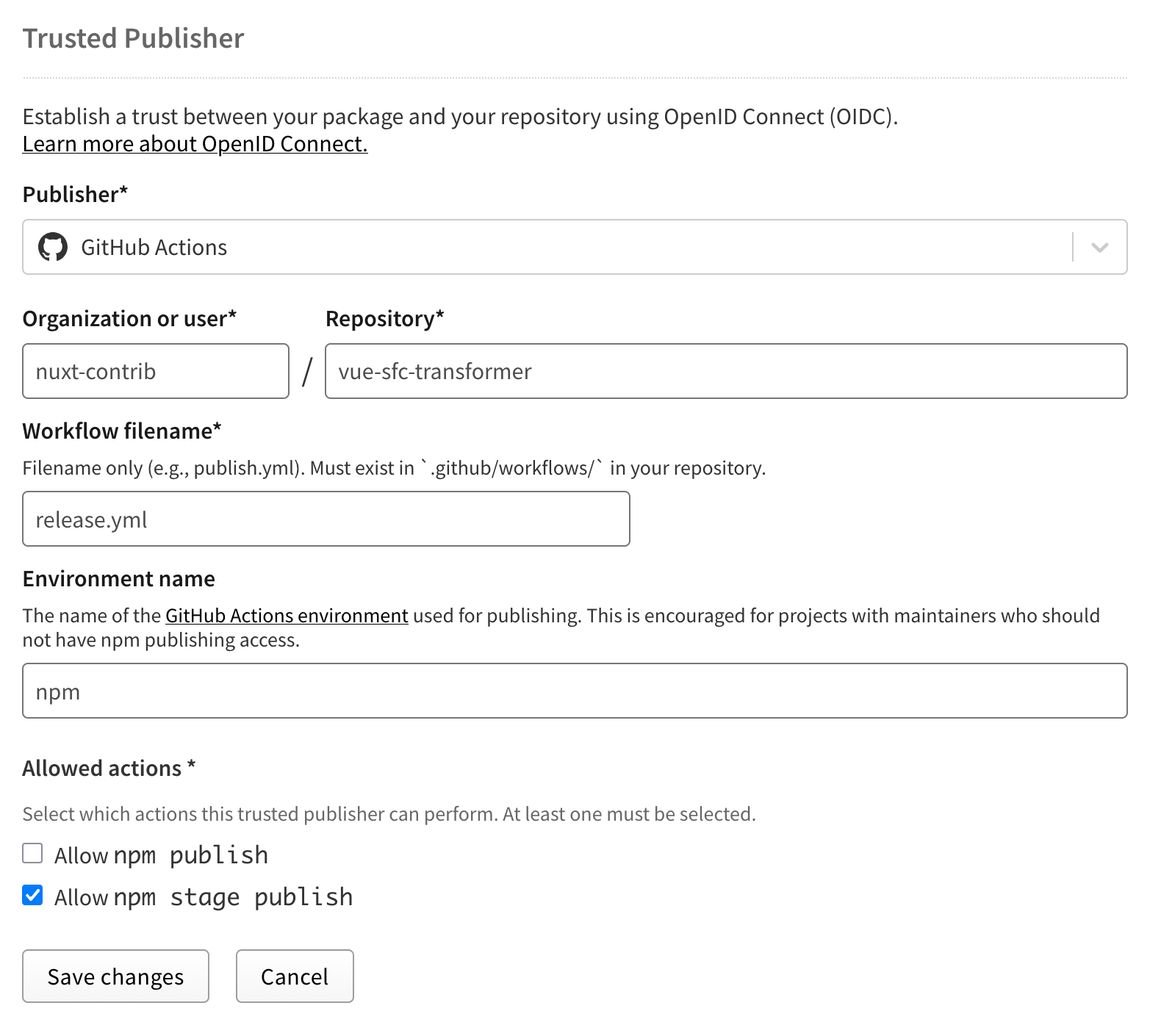
- Create a GitHub environment named
npm. You can scope it tov*tags, and configure any restrictions on it (such as requiring approvals if you want).
3. Add the following workflow to your repo in .github/workflows/release.yml, and you're done!
name: release

on:
  push:
    branches: [main]
  pull_request_target:
    types: [closed]
    branches: [main]
  # this is required to trigger releases when the release PR is merged, or to rerun a release if needed
  workflow_dispatch:

permissions: {}

jobs:
  # Parse commits since the last tag, push a `release/vX.Y.Z` branch, open
  # or update a draft release PR, and close any superseded release PRs
  # (e.g. `release/v1.0.1` when the bump is now `release/v1.1.0`).
  pr:
    if: github.event_name == 'push' && github.ref == format('refs/heads/{0}', github.event.repository.default_branch)
    runs-on: ubuntu-latest
    permissions:
      contents: write       # push the `release/vX.Y.Z` branch and delete superseded ones
      pull-requests: write  # create a release PR, update its body, close superseded PRs
    steps:
      - uses: danielroe/uppt/pr@02a45b8fc28aebb98abf0612ba44e2a4cbb612fd # v0.3.0
        with:
          token: ${{ secrets.GITHUB_TOKEN }}

  # The release PR was merged: tag the squash commit, cut a GitHub release
  # from the PR body, and dispatch the publish workflow. The `release/v`
  # head-ref guard keeps regular feature-PR merges from triggering this.
  release:
    if: |
      github.event_name == 'pull_request_target'
      && github.event.pull_request.merged == true
      && startsWith(github.event.pull_request.head.ref, 'release/v')
    runs-on: ubuntu-latest
    permissions:
      contents: write       # push the `vX.Y.Z` tag and create the GitHub release
      actions: write        # `gh workflow run release.yml --ref vX.Y.Z` chained dispatch
    steps:
      - uses: danielroe/uppt/release@02a45b8fc28aebb98abf0612ba44e2a4cbb612fd # v0.3.0
        with:
          token: ${{ secrets.GITHUB_TOKEN }}

  # The chained dispatch from `release` lands here as a `workflow_dispatch`
  # event on a `vX.Y.Z` tag ref. Manual recovery uses the same path
  # (Run workflow -> pick a `v*` tag).
  publish:
    if: github.event_name == 'workflow_dispatch' && startsWith(github.ref, 'refs/tags/v')
    runs-on: ubuntu-latest
    permissions:
      contents: read        # checkout the tag
      id-token: write       # OIDC claim for npm trusted publisher
    environment: npm        # must match the trusted-publisher entry on npmjs.com
    steps:
      - uses: danielroe/uppt/publish@02a45b8fc28aebb98abf0612ba44e2a4cbb612fd # v0.3.0
Important
Once you add this workflow, it is strongly recommended to run npx pin-github-action .github/workflows/release.yml to pin each subaction's version to a SHA.
pull_request_target is a well-known footgun, but is used safely in this action:
- It checks out the squash commit on the default branch, not the PR.
- It does not install dependencies or run anything from the codebase being released.
- It reads a single value from the codebase -
package.json#version- which is validated against a strict semver regex. - All subprocess calls use
execFileSyncwith argv arrays, and the generated PR body is passed as an env var and forwarded togh release create --notesas a single arg.
Whenever you push to the default branch, this action parses conventional commits since the latest semver tag, decides the next bump (major, minor or patch) and creates a release/vX.Y.Z branch with the version bump, and opens or updates a draft PR against the base branch.
Tip
You can edit this PR to add your own release notes. Anything above ## 👉 Changelog is preserved when the changelog is updated.
| Input | Default | Description |
|---|---|---|
token |
${{ github.token }} |
GitHub token. Needs contents: write and pull-requests: write. |
base-branch |
default branch | Base branch for the release PR. |
node-version |
24 |
Node version for the scripts. Needs --experimental-strip-types (Node 22.6+, 24+ recommended). |
checkout |
true |
Set to false if the caller has already checked out with fetch-depth: 0. |
When you merge a release PR, this subaction tags that commit, creates a GitHub Release using the PR body as notes, then dispatches the publish workflow on the new tag.
| Input | Default | Description |
|---|---|---|
token |
${{ github.token }} |
GitHub token. Needs contents: write and actions: write. |
node-version |
24 |
Node version for the scripts. Needs --experimental-strip-types (Node 22.6+, 24+ recommended). |
publish-workflow |
release.yml |
Workflow filename to dispatch after tagging. Must declare workflow_dispatch. |
checkout |
true |
Set to false if the caller has already checked out github.event.pull_request.merge_commit_sha. |
This subaction runs pnpm pack (if you have a pnpm-lock.yaml) and then runs npm stage publish with OIDC authentication. The staged version then needs to be approved by a maintainer with 2FA on npmjs.com before it goes live.
| Input | Default | Description |
|---|---|---|
node-version |
24 |
Node version for the scripts and for npm stage publish. Needs --experimental-strip-types (Node 22.6+, 24+ recommended). |
npm-access |
public |
npm access level (public or restricted). |
checkout |
true |
Set to false if the caller has already checked out the tag ref. |
For publish to work end to end you need:
- An npmjs.com trusted-publisher entry per package, pointing at the caller's
release.ymland thenpmenvironment, with thenpm stage publishpermission chip. - A GitHub environment named
npm(or whichever name you put on the publish job). - The package must already exist on npmjs.com;
npm stage publishcannot stage a brand-new package.
Inspired by unjs/changelogen and antfu/changelogithub.
There are also a number of other actions and workflows you might want to check out, including:
Made with ❤️
Published under MIT License.