










Open-FDD is an open-source knowledge graph for building technology systems, specializing in fault detection and diagnostics (FDD) for HVAC. It helps facilities optimize energy use and cut costs; because it runs on-premises, facilities never have to worry about a vendor hiking prices, going dark, or walking away with their data. The platform is an AFDD stack designed to run inside the building, behind the firewall, under the owner’s control. It transforms operational data into actionable, cost-saving insights and provides a secure integration layer that any cloud platform can use without vendor lock-in. U.S. Department of Energy research reports median energy savings of roughly 8–9% from FDD programs—meaningful annual savings depending on facility size and energy spend.
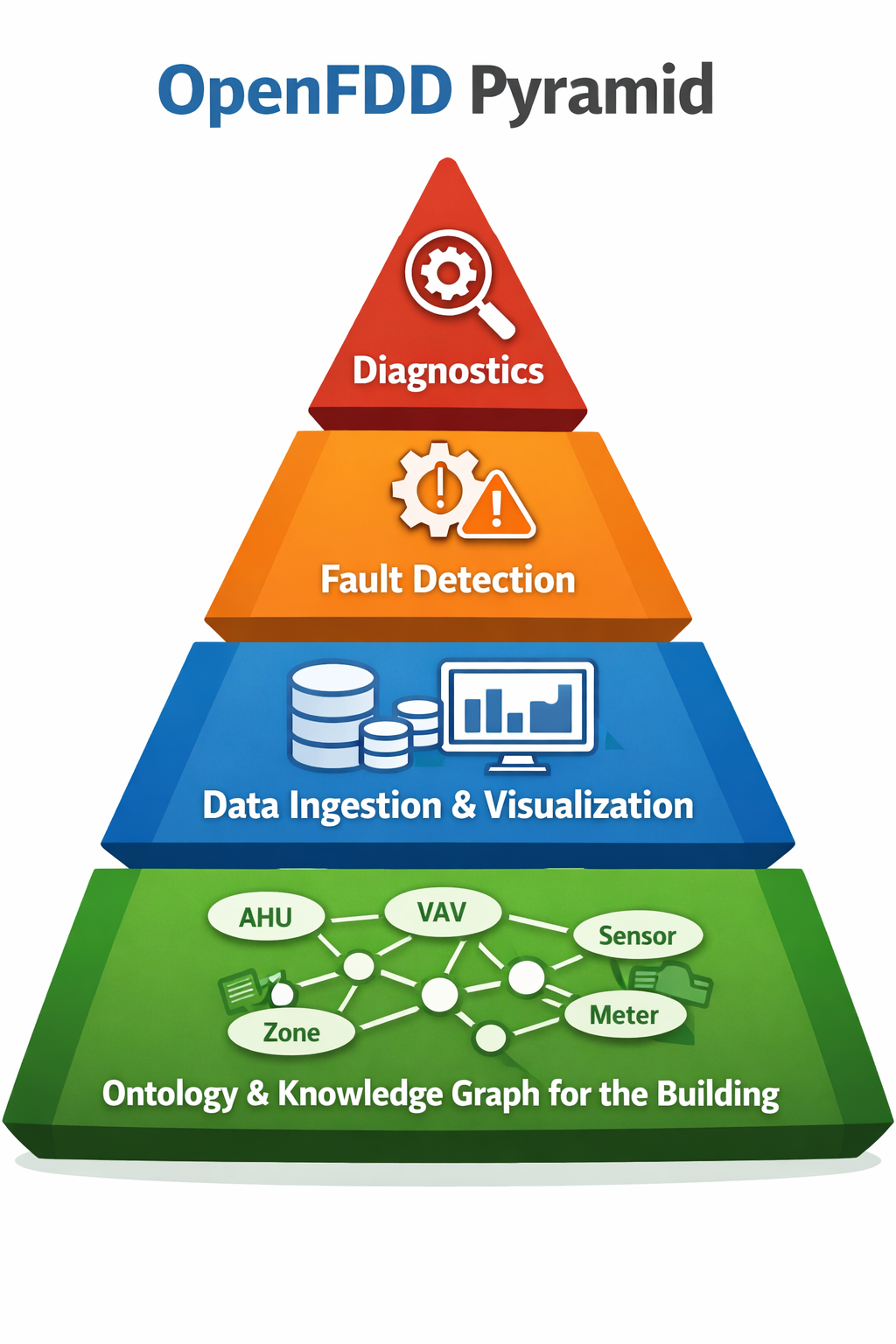
The building is modeled in a unified graph: Brick (sites, equipment, points), BACnet discovery RDF, platform config, and—as the project evolves—other ontologies such as ASHRAE 223P, in one semantic model queried via SPARQL and serialized to config/data_model.ttl.
Open-FDD uses Docker and Docker Compose to orchestrate and manage all platform services within a unified containerized environment. It has been tested on Ubuntu Server and Linux Mint running on x86-based systems.
git clone https://github.com/bbartling/open-fdd.git
cd open-fdd
./scripts/bootstrap.sh
This will start the full AFDD edge stack locally. The stack includes Grafana, TimescaleDB, and a Python rules engine built on pandas for time-series analytics; the default protocol is BACnet for commercial building automation data. Future releases will add other data sources such as REST/API and Modbus.
To run the test suite and formatter locally (no Docker required for tests):
cd open-fdd
python3 -m venv .venv
source .venv/bin/activate   # or: .venv/bin/activate on Windows
pip install -e ".[dev]"
pytest open_fdd/tests/ -v
Use the dev extra so all dependencies (pytest, black, psycopg2, pydantic-settings, FastAPI, rdflib, etc.) are installed and every test passes. If you see ModuleNotFoundError for psycopg2 or pydantic, run pytest with the venv’s Python (e.g. python -m pytest) after pip install -e ".[dev]". See CONTRIBUTING.md for styleguides.
Use the export API and an LLM (e.g. ChatGPT) to tag BACnet discovery points with Brick types, rule inputs, and equipment; then import the tagged JSON so the platform creates equipment by name and links points without pasting UUIDs. For full workflow and deterministic mapping (repeatable, rules-style tagging), see AGENTS.md and docs/modeling/llm_mapping_template.yaml.
Canonical prompt (as defined in AGENTS.md) — copy-paste this into ChatGPT or your LLM:
I use Open-FDD. I will paste the JSON from GET /data-model/export (and optionally my site identifier).

Your job:
1. **Keep every field** from each point (bacnet_device_id, object_identifier, object_name, external_id, point_id if present); add or fill in: brick_type (Brick class, e.g. Supply_Air_Temperature_Sensor — with or without "brick:" prefix), rule_input (short slug for FDD rules, e.g. ahu_sat, zone_temp), polling (true for points that must be logged for FDD, false otherwise), and unit when known (e.g. degF, cfm).
2. Assign points to equipment by name only: use "equipment_name": "AHU-1" or "VAV-1" (do NOT use equipment_id or any UUIDs for equipment).
3. For site_id: use exactly the value from the export. **Important:** Call GET /data-model/export**?site_id=BensOffice** (or your site name) so the export pre-fills site_id on every row; if you omit that, the export has site_id null and the import will only succeed when there is exactly one site in the database (it will use it automatically). Accepted formats: "site_262dcf0e_b1ec_42ad_b1eb_14881a1516ab" (TTL) or UUID "262dcf0e-b1ec-42ad-b1eb-14881a1516ab".
4. In the "equipment" array (separate from points), use equipment by name and set feeds/fed_by:
   - Each item: "equipment_name": "AHU-1" or "VAV-1", "site_id": "<same site_id as in points>".
   - AHU feeds VAV: use "feeds": ["VAV-1"] or "feeds_equipment_id": "VAV-1".
   - VAV fed by AHU: use "fed_by": ["AHU-1"] or "fed_by_equipment_id": "AHU-1".

Return ONLY valid JSON with exactly two top-level keys: "points" (array) and "equipment" (array). No "sites", "equipments", or "relationships". No placeholder UUIDs — use the site_id from the export and equipment names (AHU-1, VAV-1) everywhere. Return the full list of points (recommended) or only those you need for FDD/polling; the import creates or updates only the points you send. If the same external_id appears twice (e.g. two devices with object_name "NetworkPort-1"), the import updates the existing point for that site+external_id; the last row wins.
If OpenFDD nails the ontology, the project will be a huge success: an open-source knowledge graph for buildings. Everything else is just a nice add-on.
Optional: rdflib (Brick TTL), matplotlib (viz)
Contributions welcome — especially bug reports, rule recipes (see the expression rule cookbook), BACnet integration tests, and documentation. See CONTRIBUTING.md for how to get started.
MIT