Knowledge Base
Virtually all Artificial Intelligence applications involve a knowledge representation which stores data for use by AI agents in their decision-making processes. Curvature provides a comprehensive knowledge base feature which serves to house such data. More specifically, all decisions in Curvature's AI model are derived from information stored in the knowledge base.
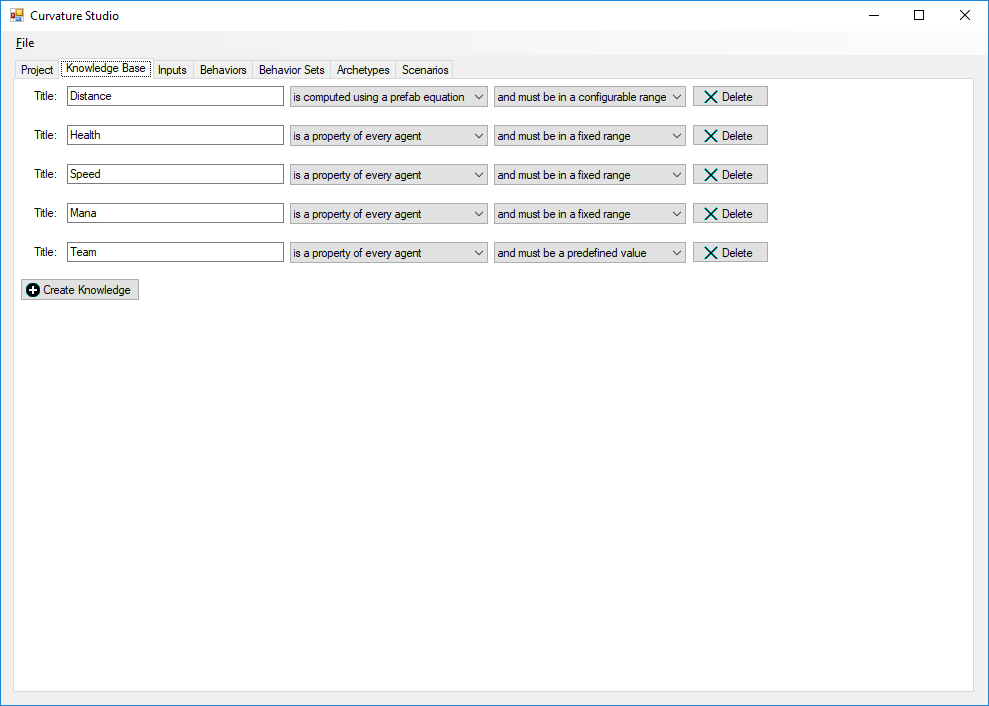
Curvature can store arbitrary data associated with each agent in a simulation, or scenario. Some types of knowledge can also be derived from other information, typically via a formula or equation. A classic example of derived knowledge is distance - the positions of two agents in a simulation are "built in" to the world, and the distance between those two agents can be computed using a simple equation.
For Curvature AI designs, it is typically sufficient to store numeric data (such as health, armor, etc.) in the knowledge base as properties. Properties can be investigated by considerations to help make determinations about a given agent. As an example, a Health property could be used to store the relative "hit points" of an agent; a second agent could use a consideration to inspect this property and decide if the agent needs to be "healed" using a med-kit.
There are some built-in equations that can be used to derive properties as well, distance again being the classic example case. Additional equations can be added without limit to the raw source code if desired.
Knowledge records in Curvature can be parameterized. For instance, a health value can be limited to the range [0, 100]. A distance might have a configurable range, meaning that individual considerations can specify the minimum and maximum distance over which the consideration operates.
Knowledge is independent of actual parameterization settings, however. In other words, knowledge is just a numerical fact about the world. In order to "care" about that knowledge, our AI must use an input axis - a mapping from knowledge to importance.