


PR Sheriff is a tiny, deterministic pull request risk checker for busy open-source maintainers. It catches oversized changes, missing tests, and edits to sensitive files before review time is spent.
It has no runtime dependencies, sends no code anywhere, and works in any Git repository.
See PR Sheriff working in the demo repository:
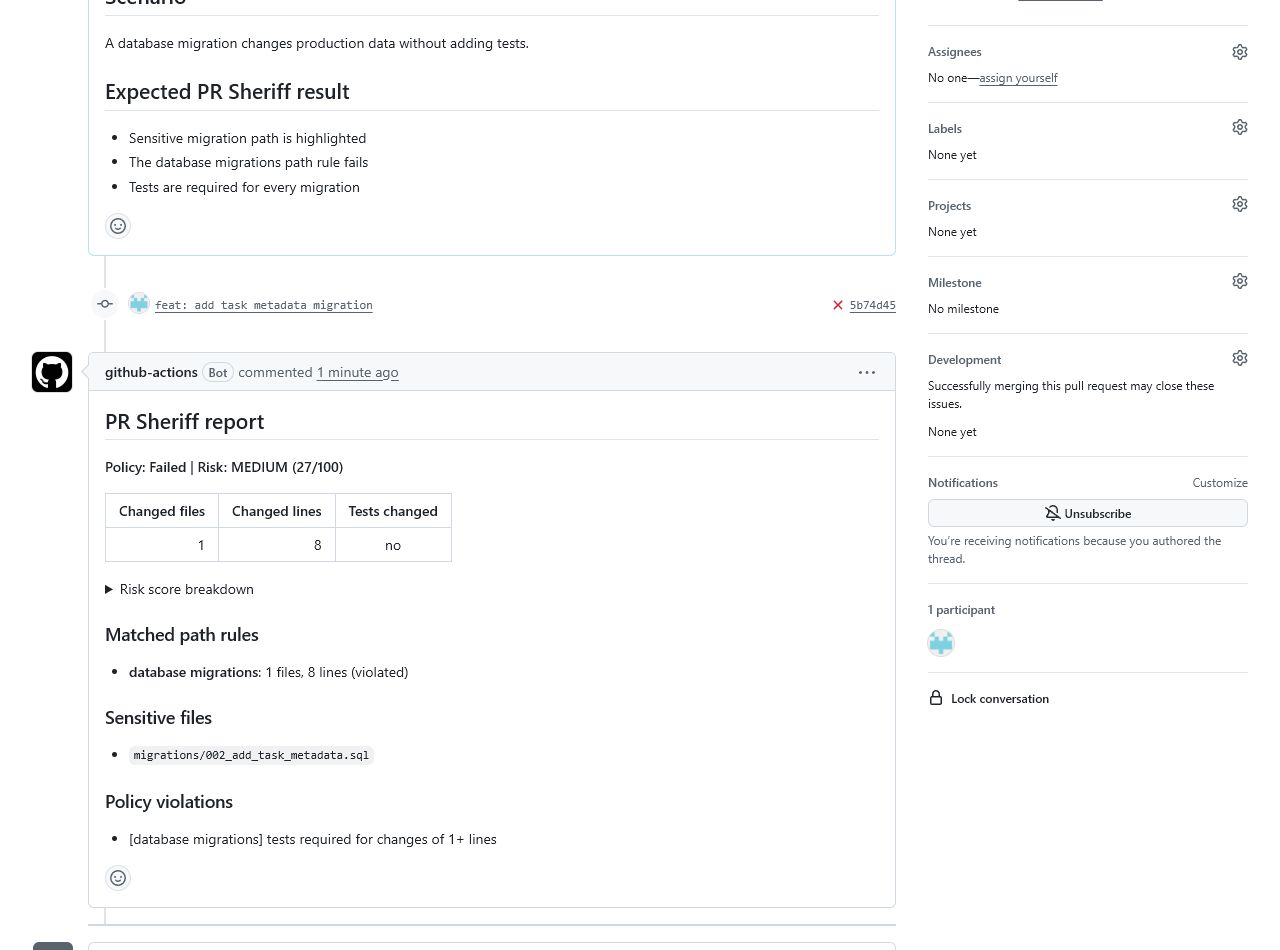
Large or sensitive pull requests consume disproportionate review time. PR Sheriff gives contributors fast, predictable feedback before a maintainer starts reviewing:
- contributors learn when a change needs tests or should be split;
- maintainers see sensitive paths and review risk immediately;
- teams keep policy in a small, version-controlled JSON file;
- every decision remains deterministic and explainable.
python -m pip install pr-sheriff
pr-sheriff install-github --detect
Commit the two generated files and open a pull request. PR Sheriff starts in
advisory mode, so it reports risks without blocking contributors. Detection
uses root project manifests and lockfiles, and falls back to the safe default
policy when no known markers exist. Use --preset python or
--preset javascript to choose explicitly, or add --mode enforce when the
policy is ready to become required.
For mixed Python and JavaScript repositories, detection combines both presets. Only root manifests and lockfiles are considered, so nested examples and vendored projects cannot silently change the selected policy.
For local-only checks:
pr-sheriff init --preset python
pr-sheriff check --base origin/main
Example output:
PR risk: MEDIUM (39/100)
Changed: 3 files, 94 lines
Sensitive files:
  - .github/workflows/release.yml
Policy check passed.
The command exits with 1 when policy violations exist, making it suitable for
CI and pre-push hooks. Use --json for integrations.
Start with --advisory to report violations without blocking contributors:
pr-sheriff check --base origin/main --advisory- Maximum changed lines and files
- Whether non-trivial changes include tests
- Sensitive paths such as workflows, authentication, migrations, and lockfiles
- A simple risk score that is explainable and stable
- Ignored paths that should not consume the review budget
Customize the generated .pr-sheriff.json to fit your repository. All matching
uses portable glob patterns.
Add .github/workflows/pr-sheriff.yml to your repository:
name: PR Sheriff

on:
  pull_request:

permissions:
  contents: read
  pull-requests: write

jobs:
  review-risk:
    runs-on: ubuntu-latest
    steps:
      - uses: actions/checkout@v6
        with:
          fetch-depth: 0
      - uses: Hayal08/pr-sheriff@v0.6.0
        with:
          base: origin/${{ github.base_ref }}
The Action adds a report to the GitHub Job Summary, emits annotations for sensitive files and policy violations, creates or updates one pull request comment, and fails when policy is violated.
| Input | Default | Purpose |
|---|---|---|
base |
origin/main |
Base git ref for the three-dot diff |
head |
HEAD |
Head git ref for the three-dot diff |
config |
.pr-sheriff.json |
Path to repository policy |
comment |
true |
Create or update a report comment on pull requests |
mode |
enforce |
Use advisory to report without failing the check |
The Action exposes risk, score, changed-files, changed-lines, and
tests-changed outputs for later workflow steps. The policy-passed output is
false when violations exist, including in advisory mode.
Use advisory mode to learn what the policy would flag before making it a required check:
- uses: Hayal08/pr-sheriff@v0.6.0
  with:
    base: origin/${{ github.base_ref }}
    mode: advisory
Advisory mode keeps the Job Summary, PR comment, outputs, and annotations, but turns policy errors into warnings and returns a successful exit code.
Run pr-sheriff init, choose a ready-made python or javascript preset, or
add .pr-sheriff.json manually:
pr-sheriff init --preset pythonThe presets recognize ecosystem-specific test files, manifests, lockfiles, and database migrations. Generated policies remain ordinary JSON and can be customized at any time.
{
  "max_changed_lines": 800,
  "max_changed_files": 30,
  "require_tests_after_lines": 120,
  "test_patterns": ["tests/**", "**/*_test.*", "**/*.test.*"],
  "sensitive_patterns": [".github/workflows/**", "**/auth/**", "**/migrations/**"],
  "ignore_patterns": ["**/*.md", "docs/**"],
  "path_rules": []
}
Unknown configuration keys are rejected so typos cannot silently weaken a policy.
Different parts of a repository can have stricter review policies. Each matched rule is shown separately in the report:
{
  "path_rules": [
    {
      "name": "database migrations",
      "patterns": ["**/migrations/**"],
      "max_changed_lines": 100,
      "require_tests_after_lines": 1
    },
    {
      "name": "frontend",
      "patterns": ["web/**"],
      "max_changed_files": 15,
      "require_tests_after_lines": 80
    }
  ]
}
Path rules support max_changed_lines, max_changed_files, and
require_tests_after_lines. Global limits still apply.
Human-readable, JSON, Job Summary, and PR comment reports now show how changed
lines, changed files, and sensitive paths contribute to the risk score. JSON
consumers can use score_breakdown and path_rule_results for custom
dashboards or workflow decisions.
Open a pull request that changes more than require_tests_after_lines without
changing a test file. PR Sheriff will add a policy violation to its single
updatable PR comment and fail the check. Add a test file and push again to see
the same comment update and the check pass.
For pull requests from forks, GitHub may provide a read-only token. In that case, PR Sheriff still runs but reports that it could not update the comment.
PR Sheriff does not claim to decide whether code is good. It gives maintainers a consistent early warning so they can ask for smaller PRs, tests, or a deeper security review.
See CONTRIBUTING.md to help shape the project.
First-time contributors are welcome. Start with a
good first issue
or read CONTRIBUTING.md for the local development workflow.
Useful ways to help:
- try PR Sheriff in a real repository and report confusing behavior;
- improve docs and policy examples;
- add focused policy checks with tests;
- share maintainer workflows that should influence the roadmap.
Please open an issue before starting a large change. Small pull requests are easier to review and are a good way to get involved.