
An open, FHIR-based data foundation for nursing documentation, clinical reasoning, safety and equity — built by nurses, in the open.






Deutsch · Español · Français · 日本語 · 한국어 · Português · Русский · 中文
📖 Read the Implementation Guide · 🚀 Try the Live Demo · 🤝 Contribute · ⭐ Star this repo
If ONC is useful to your work, starring it helps other nurses and health-tech teams find it — that's the whole point of building this in the open.
⚠️ Standards status: Trial Use — Pre-Ballot Community Release. ONC-IG has not undergone formal HL7 standards balloting or independent clinical/peer review. Version and status labels reflect this project's own development lifecycle, not external endorsement. It is a specification, not a deployed product — implementers remain responsible for their own DCB0129/DCB0160 clinical safety case. The included applications and AI features are research prototypes for synthetic or appropriately de-identified data, not clinical decision systems. Read PRODUCT_BOUNDARIES.md, CLINICAL_SAFETY.md and STANDARDS_ROADMAP.md.
- What is the Open Nursing Core?
- Why it matters
- Key features
- Architecture
- Quick start
- Repository map
- Project leadership
- Standards & governance
- Contributing & security
- Repository traffic
- Citation
- License
Open Nursing Core (ONC) is an open-source platform and standards-aware AI engine for nurse-led clinical intelligence. It combines healthcare standards, clinical reasoning and deployable tools to support safe, person-centred nursing practice.
It is organised around the complete nursing process — Assessment, Diagnosis, Planning, Implementation, Evaluation (ADPIE) — rather than a purely pathology-driven medical model, and is informed by PRSB documentation standards, the NANDA-I taxonomy and open-access person-centred practice literature from the International Practice Development Journal (IPDJ).
| Pillar | What it means |
|---|---|
| 🫀 Clinical safety | Validated "safety gate" instruments (NEWS2, Braden, Waterlow, MUST…) with computable escalation logic. |
| 💚 Relational care | First-class "What Matters to Me" and patient-story data, and empathetic, person-centred language. |
| 🛡️ Equitable by design | Leads with the Monk Skin Tone Scale and structured reasonable-adjustment records (Equality Act 2010). |
| 🔗 Interoperable | HL7 FHIR R4 profiles with SNOMED CT / LOINC bindings, ready for real EHRs. |
The current release ships 60 profiles, 27 value sets, 3 code systems, 4 extensions, 1 logical model and 49 worked examples.
Too much nursing knowledge — assessment, risk, escalation, safeguarding, the person-centred detail — stays trapped in free text and disconnected systems that cannot understand what nursing contributes. That is at once a documentation, interoperability, data-quality, patient-safety and nursing-visibility problem. ONC exists to make nursing knowledge visible, reusable, structured and clinically meaningful.
The following demonstrations are not part of the normative FHIR specification and have not been approved for clinical deployment.
A research LLM demonstration that can draft candidate care-plan text for qualified human review.
- Input: "Write a care plan for Mrs. Singh, 78, with dementia."
- Output: a structured ADPIE plan that is empathetic and clinically safe.
An AI synthesis demonstration that simulates several perspectives for research and education. It is not a real MDT review and must not be represented as one.
A research audit of synthetic or de-identified documentation against the ONC Relational Care Logical Model. NANDA-I mappings remain subject to licensing and verification.
| Layer | Components |
|---|---|
| Standards | FHIR R4 · PRSB documentation standards · NANDA-I diagnoses · NHS clinical frameworks |
| Intelligence | Care-plan generation · documentation audit · evidence retrieval · MDT reasoning agents |
| Application | Nursing education · clinical audit · simulation · specialist apps |
| Deployment | Docker · Hugging Face · cloud platforms |
The full Implementation Guide — every profile, extension and terminology — is published at opennursingcoreig.com.
👉 Launch the app on Hugging Face
Requires Node.js and SUSHI (npm install -g fsh-sushi).
git clone https://github.com/Clinical-Quality-Artifical-Intelligence/open-nursing-core-ig.git
cd open-nursing-core-ig
sushi . # compile the FSH profiles to FHIR resourcescd open-nursing-core-ig
pip install -r requirements.txt
streamlit run app_phase2.py| Path | Contents |
|---|---|
input/fsh/ |
FHIR Shorthand (FSH) profile, extension and terminology sources |
input/pagecontent/ |
Narrative IG pages (ADPIE, safety, equity, security, terminology…) |
core/, db/, ml/ |
Experimental application components (auth, database, ML analytics) |
analytics/equity/ |
Equity analytics pipeline — pressure-ulcer detection timeliness by Monk skin tone |
okf/ |
Agent-readable knowledge bundle (Open Knowledge Format) generated from the IG |
app_phase2.py |
Streamlit application entry point |
hf_space/ |
Hugging Face Space (model demo) |
.github/workflows/ |
CI: IG publish, PR validation, CodeQL, traffic tracking |
| Name | Role |
|---|---|
| Kumbi Kariwo | Health Inequalities & AI Equity Lead · Co-lead (Monk Skin Tone & Equity profiles) |
| Lincoln | Nurse Citizen Developer · FHIR IG Lead · Practice Educator, NMC Registered |
ONC-IG is a nurse-led initiative — clinical leadership by nurses, for nurses — built on open standards and hosted by the United Nations (UNICC).
GitHub main is the source of truth and is synchronised to the UNICC GitLab
repository using the guarded process described in MIRRORING.md.
ONC-IG is a trial-use, pre-ballot community release — see the callout at the top of this page. STANDARDS_ROADMAP.md sets out the concrete path toward formal review and endorsement, including:
- Immediate, loud "trial use" labelling across the IG so nothing is mistaken for a balloted standard
- Engagement with the Professional Record Standards Body (PRSB) formal assurance process, since the IG already grounds itself in the PRSB Nursing Care Needs standard
- Participation in an HL7 FHIR Connectathon to gather implementer feedback ahead of any ballot submission
- Identifying an HL7 Work Group sponsor (e.g. Patient Care WG) as a precondition for a formal Standard for Trial Use (STU) ballot
- Resolving the NANDA-I licensing/terminology-canonical gap tracked in issue #123
We welcome contributions from nurses, developers, clinical informaticians and researchers. Start with CONTRIBUTING.md and the current priorities in ROADMAP.md.
Quick links
- 🩺 Report a clinical error
- 🧬 Propose a new FHIR profile
- 🏛️ openEHR archetype alignment
- 💬 Join the discussion
How pull requests are protected. Every PR is automatically validated (SUSHI build + Python checks), scanned for vulnerabilities with CodeQL, and requires review from a code owner before it can merge to main. Dependencies are monitored by Dependabot, and secrets are blocked by push protection. See SECURITY.md to report a vulnerability.
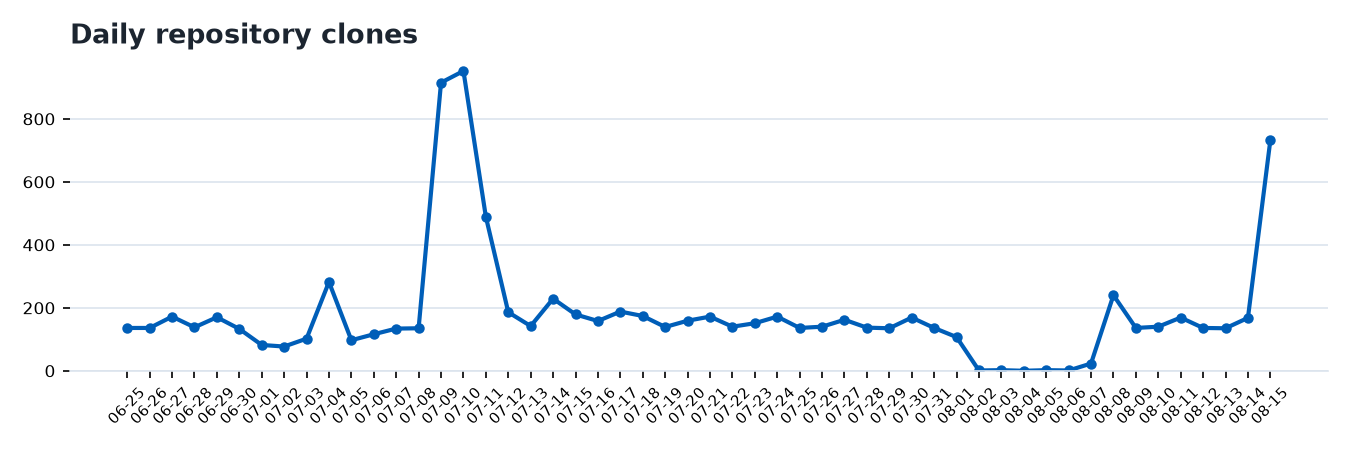
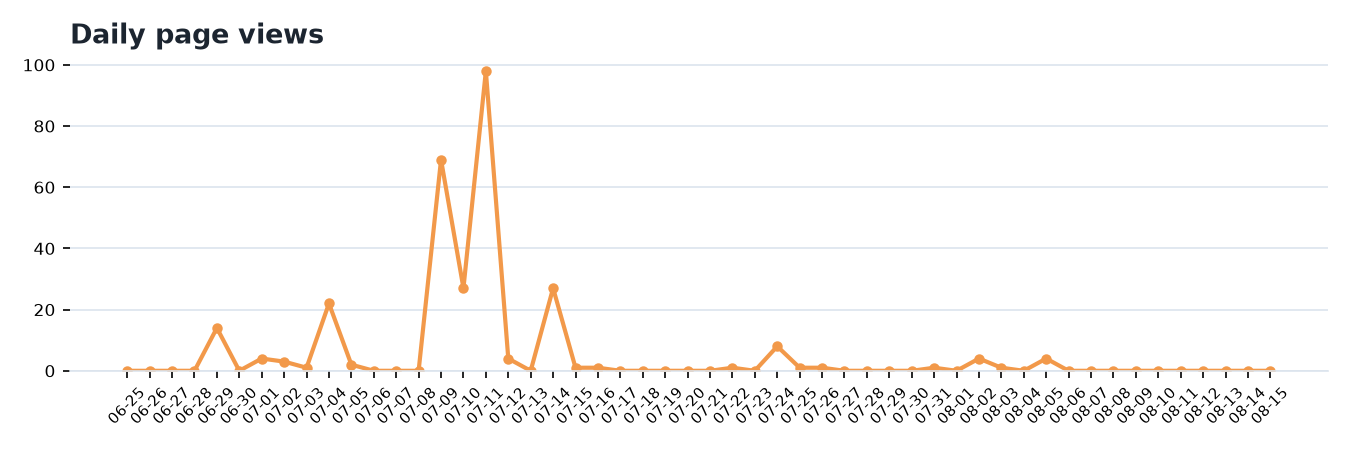
Clone and view counts are snapshotted weekly (GitHub only keeps 14 days) and stored in traffic/ with the badges shown at the top of this page. Charts below are regenerated on every snapshot. See traffic/README.md for the full history and CSVs.
Note on clone counts. GitHub's Traffic API counts every
git clone/checkoutoperation, including this repository's own CI workflows (CodeQL, PR validation, Hugging Face sync). A burst of pull requests or pushes will show up as a clone spike even with no new external interest — visible in the chart below around a period of heavy CI activity. Treat the trend as a proxy for repository activity, not a clean count of distinct external users; stars are a more reliable adoption signal.
If you use ONC-IG in research or clinical systems, please cite:
@software{ONC_IG_2026,
  author    = {Kariwo, Kumbi and NurseCitizenDeveloper, Lincoln},
  title     = {Open Nursing Core FHIR Implementation Guide (ONC-IG)},
  version   = {1.0.0},
  year      = {2026},
  url       = {https://opennursingcoreig.com},
  license   = {MIT}
}
Or use the "Cite this repository" button in the GitHub sidebar (CITATION.cff).
Released under the MIT License.
Powered by NurseCitizenDeveloper · Together, we code care.