The perfomance of divachain does not scale. The more members in a chain, the slower it gets. This is one of the well known issues of voting systems (bft) without validator.
One of the solutions might be to introduce a hierarchical ring network.
Each ring forms an independent chain. The information stored within a chain is related to its class (aka "role") within the hierarchical ring network.
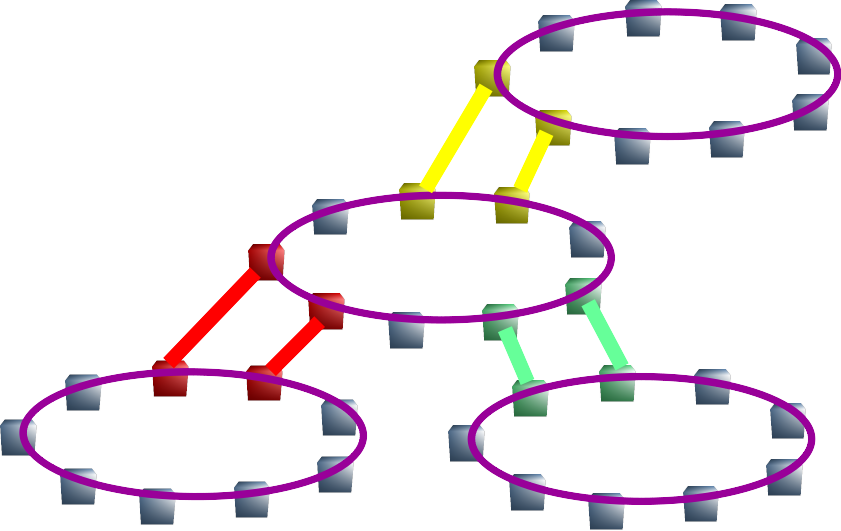
Each ring votes only for it's own data. In the image above it would be nine votes per ring. However, a ring might have less or more members, let's say between 5 and 13. If a ring drops below 5 active members, it dies and the active members have to join other rings of the same class. If a ring has 13 members, it splits into two rings of the size 6 and 7. Node meta data (node stake) is always exported to the upper level.

The perfomance of divachain does not scale. The more members in a chain, the slower it gets. This is one of the well known issues of voting systems (bft) without validator.
One of the solutions might be to introduce a hierarchical ring network.
Each ring forms an independent chain. The information stored within a chain is related to its class (aka "role") within the hierarchical ring network.
Each ring votes only for it's own data. In the image above it would be nine votes per ring. However, a ring might have less or more members, let's say between 5 and 13. If a ring drops below 5 active members, it dies and the active members have to join other rings of the same class. If a ring has 13 members, it splits into two rings of the size 6 and 7. Node meta data (node stake) is always exported to the upper level.