Problem Description • Manual • Submission Guidelines • Scoring Criteria • Appendix
Spacewalk is a company that discovers the value of space.
In order to discover the value of space, it's important to make a plan for space.
There two method to make a plan for space, division and filling.
For parking lot planning, filling is suitable method.
You will solve the simplified version of paking lot planning.
(with no legal constraints!)
Suppose there are a piece of land, and we are planning to make a parking lot.
In order to maximize the value of the land, it's crucial to make a parking layout of maximum number of parking spaces.
The optimal parking layout depends on the condition of the land, especially the shape of the land.
We will give you predefined "space"(corresponds to land) and "patch"(corresponds to parking space).
Your task is to fill the space with maximum number of patches.
To fill the space, you can rotate and translate patches.
A patch have to be placed within the space, and cannot overlap other patches.
- Set of space to fill
- 10 predefined spaces are given
- Array of polygon vertex coordinates
- Patch to place
- Single unit patch of which the centroid is on origin and zero rotation is given
- Array of polygon vertex coordinates
- State information
- When action is applied, information of subsequent state is calculated and offered
- Patch placement with rotation and translation parameter
- Fill the target spaces with maximum number of patches
- Target spaces are given predefined spaces (There are 10 predefined spaces)
- The number of trial have to be minimized at inference time
- When an action is applied, trial count gains by 1, regardless of the action validity
- When the action is invalid, environment fails to place the patch, and patch won't be placed but trial number will be counted
- Patch have to be placed within the space
- Patch cannot overlap other patches
- You can wrap the given environment with your custom environment
- Given environment provides minimal information to solve the problem
- Depends on your method, these information may not sufficient to solve the problem
- You can create a wrapper environment to generate additional information
- If you are familiar with some frameworks(like Gym, etc.), you can use given environment as a library and create wrapper environment inherits framework you want to use
- If you create a wrapper environment, you have to submit that as well
- You have to solve the problem with just one generalized agent
- Using different agents for different spaces is prohibited
-
Generalized agent is recommended
- There are additional test spaces that we do not offer to applicants
- Good performance on those is not mandatory, but recommended
- Extra points will given for performance on those test set
-
Minimal rule is recommended
- To make better performance, simplifying problem with adding some rules is effective way
- But, the more we add rules, versatility of the agent decreases and not adaptable to complex problem
- The real problem is much more complex than this toy problem, that we have to minimize rules for agent
- Don't hesitate to add rules if you think they are essential to solve the problem, but avoid adding unnecessary rules
spwkml package offers environment class for problem definition above.
You can make environment instance with it.
from spwkml import PolygonFillEnv

env = PolygonFillEnv()
PolygonFillEnv class has several properties and methods.
env.spaces
- Space samples to place patches
- It consists of several spaces
- Canvas bound is
(-10, -10, 10, 10), and you don't have to consider space out of bound - You can select space among these spaces with env.select_space() method
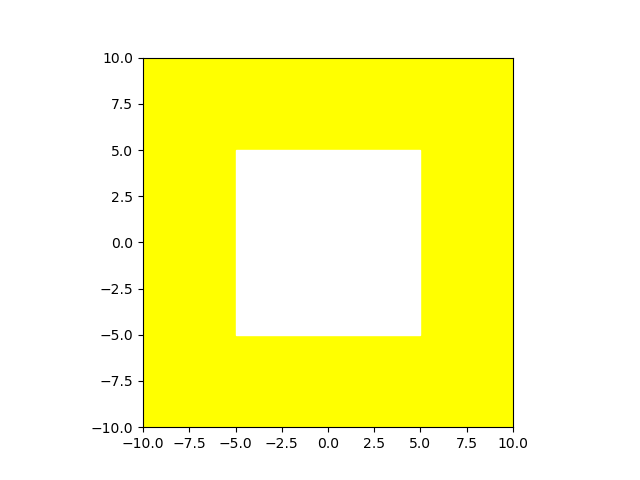
env.space
- Dictionary of two items
- shell : coordinate array of polygon shell
- holes : list containing coordinate array of polygon hole
- Shell will form outer wall, and holes will form inner wall of space polygon
{
    'shell': array([[-10., -10.],
                    [-10.,  10.],
                    [ 10.,  10.],
                    [ 10., -10.],
                    [-10., -10.]]),
    'holes': [
        array([[-5., -5.],
                [ 5., -5.],
                [ 5.,  5.],
                [-5.,  5.],
                [-5., -5.]])
    ]
}
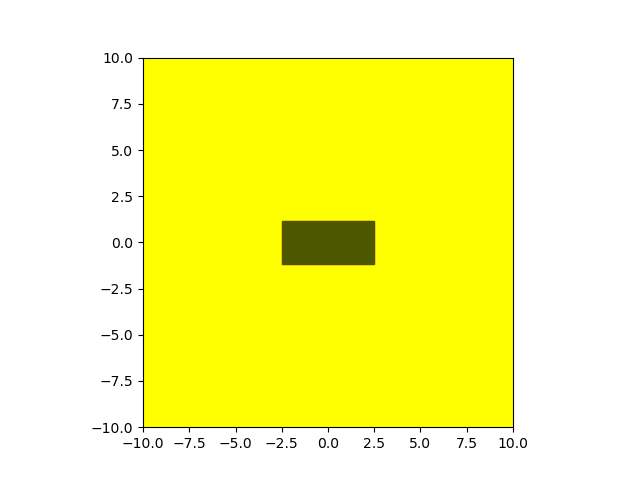
env.patch
- Coordinate array of base patch to fill space
- Its centroid is on
(0, 0) - The action will be placing the patch, rotated and translated from this base patch
- Fixed value (Just one type of base patch is considered)
[[-2.5, -1.15], [2.5, -1.15], [2.5, 1.15], [-2.5, 1.15], [-2.5, -1.15]]
env.new_patch
- Coordinate array of latest patch applied by action
- It's updated regardless of action validity
- When the action is invalid and the patch is not placed,
env.new_patchwill be updated though
- When the action is invalid and the patch is not placed,
env.placed_patches
- List containing coordinate array of placed patches
- Its sequence correspond to
env.stepsequence - Invalid patch won't shown on this property
env.n_patches
- Number of patches placed on the space
- It counts valid patches only
env.n_steps
- Number of trial to place the patch on the space
- Every patch placement increments this property, whether valid or invalid
env.select_space(index)
- Select the space from predefined spaces with index
- It select the space from
env.spaces
- It select the space from
- It resets the environment
- Placed patches is removed
env.n_stepscounter is reset
env.step(patch_x, patch_y, patch_angle)
- Apply action
- args
patch_x (float): The centroid x position of patch. The range is -10 to 10patch_y (float): The centroid y position of patch. The range is -10 to 10patch_angle (float): The rotation of patch. The range is -pi/2 to pi/2. (unit:radian)
- returns
(dict): Next state informationis_valid (bool): If applied action is valid or notarea_out_of_spaceandarea_intersect_patches, either one of the is non-zero, the action is invalid
n_steps:env.n_stepsupdated by the actionn_patches:env.n_patchesupdated by the actionspace:env.spaceupdated by the actionselected_patch:env.new_patchupdated by the actionplaced_patches:env.placed_patchesupdated by the actionarea_out_of_space: The area where the patch is out of spacearea_intersect_patches: The area where a patch overlaps other patches
- args
env.reset()
- Reset environment
- Remove all placed patches
- Set step counter to zero
env.render(save_img=False, path=None, fname=None, show_last=True, show_axis=True)
- Render current state. With adjusting its args, you can use image feature for training.
- args
save_img (bool): Whether or not save the image as file.path (str): Path to save image. Ifsave_imgis False, it's meaningless. Default path is./imgs(whenpathis None).fname (str): File name to save image. If save_img is False, it's meaningless. Default name isimg_i.png, andiis growing integer (whenfnameis None).show_last (bool): Whether or not color the last patch. If true, last patch is colored by translucent red.show_axis (bool): Whether or not plot the axis.
- args
With the code below, you can check how the environment works
First, with env.spaces property, you can get information of predefined spaces.
There are 10 predefined spaces.
print(env.spaces)

[
    {
        'shell': array([[-10., -10.],
                        [ 10., -10.],
                        [ 10.,  10.],
                        [-10.,  10.],
                        [-10., -10.]]),
        'holes': []
    },
    {
        'shell': array([[-10., -10.],
                        [ -3., -10.],
                        [ -3.,  10.],
                        [-10.,  10.],
                        [-10., -10.]]),
        'holes': []
    },
    {
        'shell': array([[-5., -5.],
                        [ 5., -5.],
                        [ 5.,  5.],
                        [-5.,  5.],
                        [-5., -5.]]),
        'holes': []
    },
    {
        'shell': array([[-10., -10.],
                        [-10.,  10.],
                        [ 10.,  10.],
                        [ 10., -10.],
                        [-10., -10.]]),
        'holes': [
            array([[-5., -5.],
                    [ 5., -5.],
                    [ 5.,  5.],
                    [-5.,  5.],
                    [-5., -5.]])
        ]
    },
    {
        'shell': array([[  0., -10.],
                        [ 10.,   0.],
                        [  0.,  10.],
                        [-10.,   0.],
                        [  0., -10.]]),
        'holes': []
    },
    {
        'shell': array([[  0., -10.],
                        [-10.,   0.],
                        [  0.,  10.],
                        [ 10.,   0.],
                        [  0., -10.]]),
        'holes': [
            array([[ 0., -3.],
                    [ 3.,  0.],
                    [ 0.,  3.],
                    [-3.,  0.],
                    [ 0., -3.]])
        ]
    },
    {
        'shell': array([[-10., -10.],
                        [ 10., -10.],
                        [ 10.,  -6.],
                        [ -2.,  -6.],
                        [ -2.,   6.],
                        [ 10.,   6.],
                        [ 10.,  10.],
                        [-10.,  10.],
                        [-10., -10.]]),
        'holes': []
    },
    {
        'shell': array([[-10., -10.],
                        [  8., -10.],
                        [ 10.,   7.],
                        [-10.,  10.],
                        [  0.,  -3.],
                        [-10., -10.]]),
        'holes': []
    },
    {
        'shell': array([[-10., -10.],
                        [ 10., -10.],
                        [  0.,  10.],
                        [-10., -10.]]),
        'holes': []
    },
    {
        'shell': array([[-10., -10.],
                        [  0.,  10.],
                        [ 10., -10.],
                        [-10., -10.]]),
       'holes': [
            array([[-4., -6.],
                    [ 4., -4.],
                    [-2.,  2.],
                    [-4., -6.]])
        ]
    }
]
One of predefined spaces is selected as current space, and you can get this by env.space property.
As default, first space (space of index 0) is selected as current space.
print(env.space)

{
    'shell': array([[-10., -10.],
                    [ 10., -10.],
                    [ 10.,  10.],
                    [-10.,  10.],
                    [-10., -10.]]),
    'holes': []
}
You can get fixed patch information with env.patch property.
This is unit patch, and when you apply action, this patch will be rotated, and translated.
print(env.patch)

array([[-2.5 , -1.15],
       [ 2.5 , -1.15],
       [ 2.5 ,  1.15],
       [-2.5 ,  1.15],
       [-2.5 , -1.15]])
In order to know the shape of predefined spaces, you can use env.select_space(index) method and env.render method.
There are 10 predefined spaces, so you can use index 0~9 without adding other spaces.
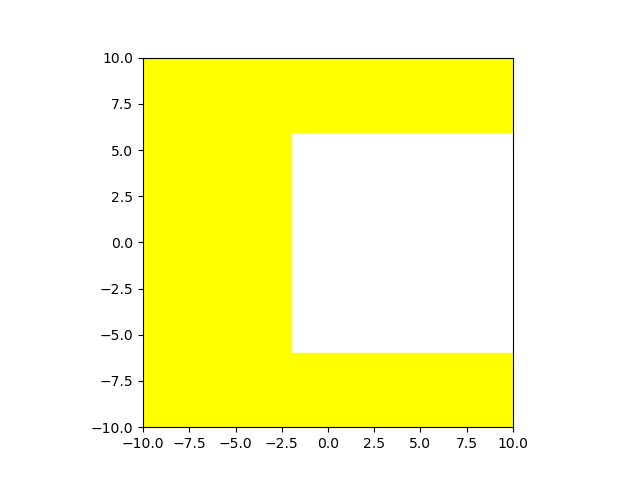
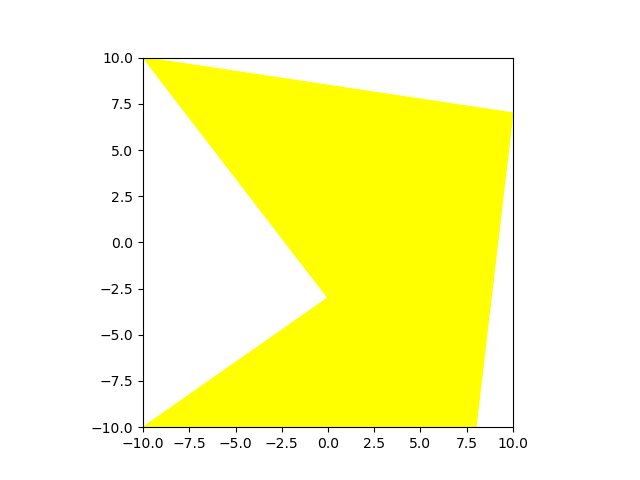
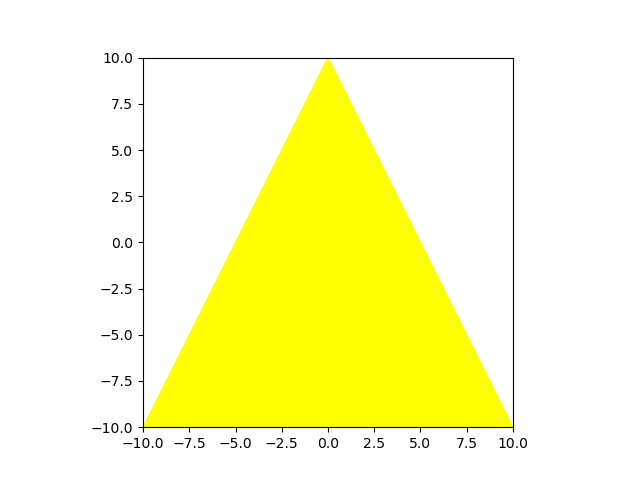
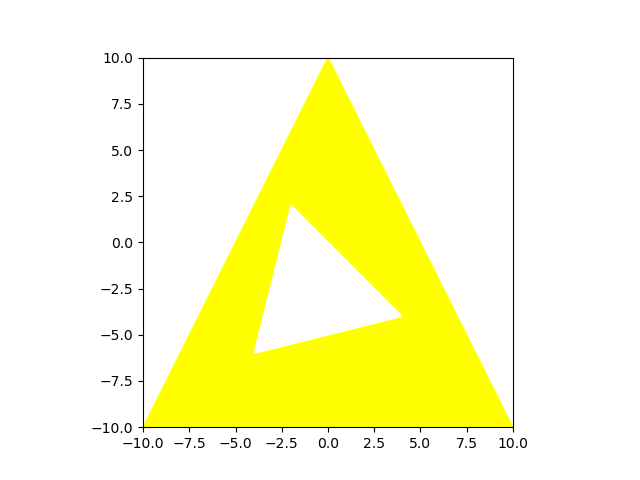
for i in range(len(env.spaces)):
    env.select_space(i)
    print(env.space)
    env.render()
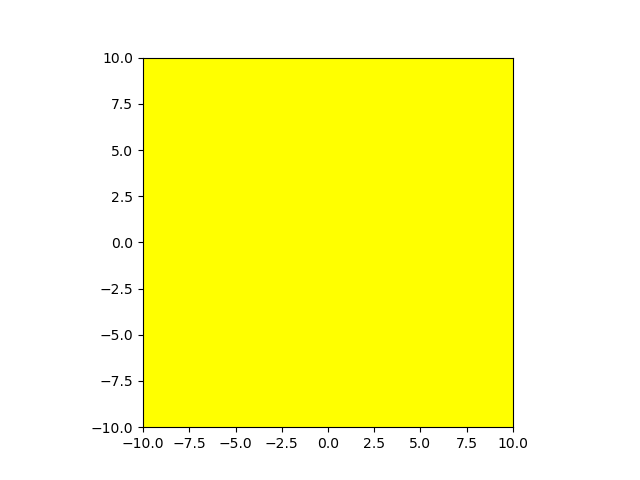
{
'shell': array([[-10., -10.],
[ 10., -10.],
[ 10., 10.],
[-10., 10.],
[-10., -10.]]),
'holes': []
}
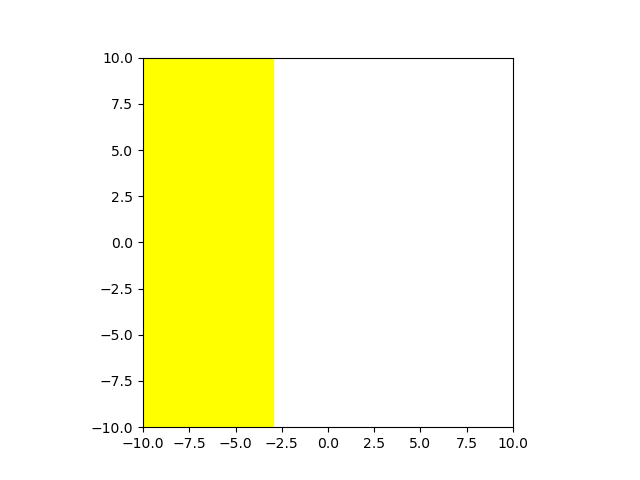
{
    'shell': array([[-10., -10.],
                    [ -3., -10.],
                    [ -3.,  10.],
                    [-10.,  10.],
                    [-10., -10.]]),
    'holes': []
}
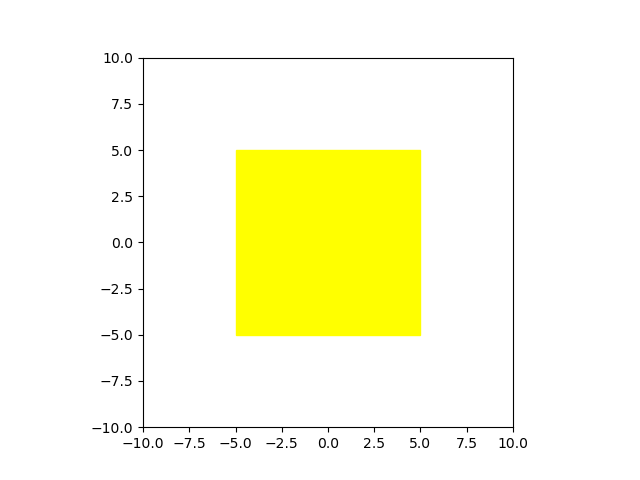
{
    'shell': array([[-5., -5.],
                    [ 5., -5.],
                    [ 5.,  5.],
                    [-5.,  5.],
                    [-5., -5.]]),
    'holes': []
}
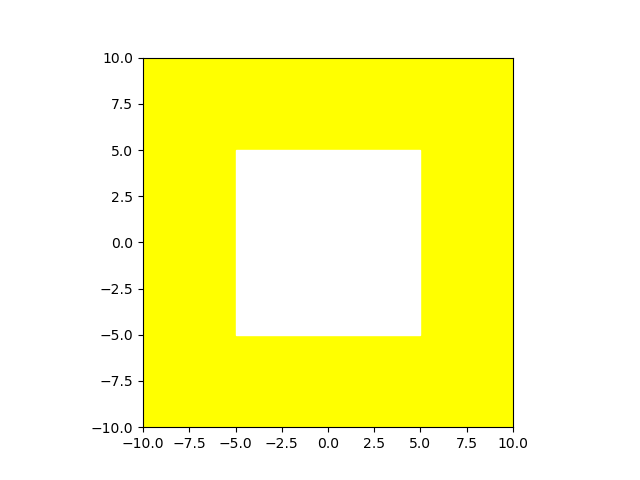
{
    'shell': array([[-10., -10.],
                    [-10.,  10.],
                    [ 10.,  10.],
                    [ 10., -10.],
                    [-10., -10.]]),
    'holes': [
        array([[-5., -5.],
                [ 5., -5.],
                [ 5.,  5.],
                [-5.,  5.],
                [-5., -5.]])
    ]
}
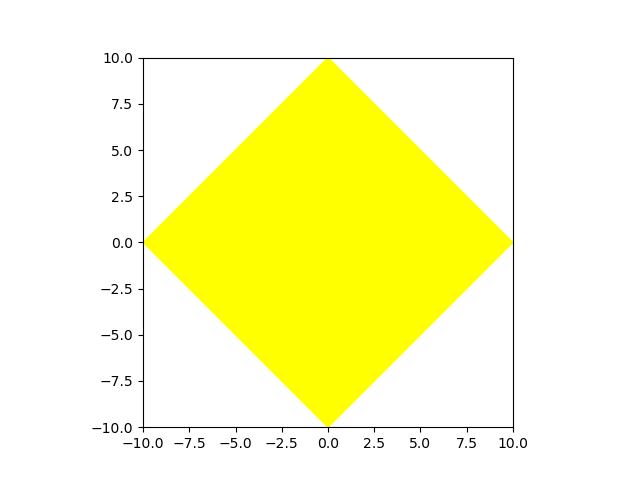
{
    'shell': array([[  0., -10.],
                    [ 10.,   0.],
                    [  0.,  10.],
                    [-10.,   0.],
                    [  0., -10.]]),
    'holes': []
}
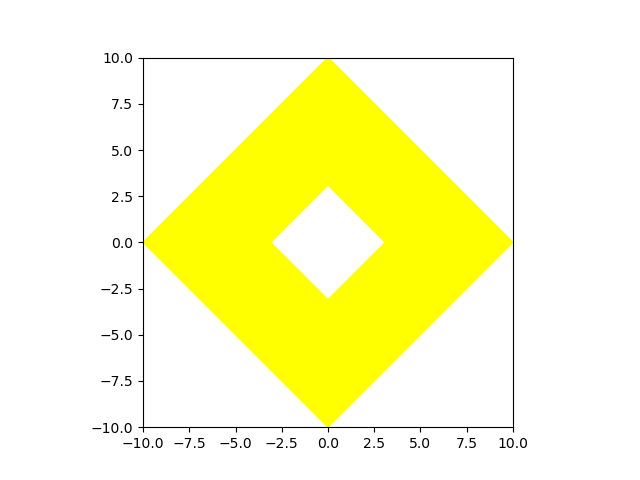
{
    'shell': array([[  0., -10.],
                    [-10.,   0.],
                    [  0.,  10.],
                    [ 10.,   0.],
                    [  0., -10.]]),
    'holes': [
        array([[ 0., -3.],
                [ 3.,  0.],
                [ 0.,  3.],
                [-3.,  0.],
                [ 0., -3.]])
    ]
}
{
    'shell': array([[-10., -10.],
                    [ 10., -10.],
                    [ 10.,  -6.],
                    [ -2.,  -6.],
                    [ -2.,   6.],
                    [ 10.,   6.],
                    [ 10.,  10.],
                    [-10.,  10.],
                    [-10., -10.]]),
    'holes': []
}
{
    'shell': array([[-10., -10.],
                    [  8., -10.],
                    [ 10.,   7.],
                    [-10.,  10.],
                    [  0.,  -3.],
                    [-10., -10.]]),
    'holes': []
}
{
    'shell': array([[-10., -10.],
                    [ 10., -10.],
                    [  0.,  10.],
                    [-10., -10.]]),
    'holes': []
}
{
    'shell': array([[-10., -10.],
                    [  0.,  10.],
                    [ 10., -10.],
                    [-10., -10.]]),
    'holes': [
        array([[-4., -6.],
                [ 4., -4.],
                [-2.,  2.],
                [-4., -6.]])
    ]
}
You will apply some actions with env.step() method and see the result of it.
5th predifined space is good to know how it works, so, choose 5th space.
It's diamond shape space with a hole in center.
env.select_space(5)
env.render()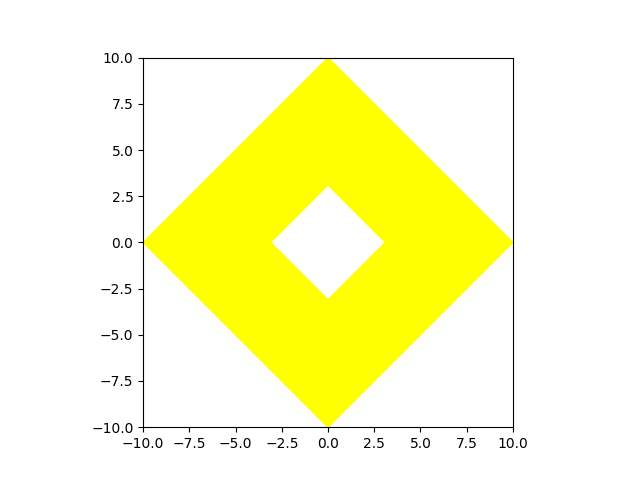
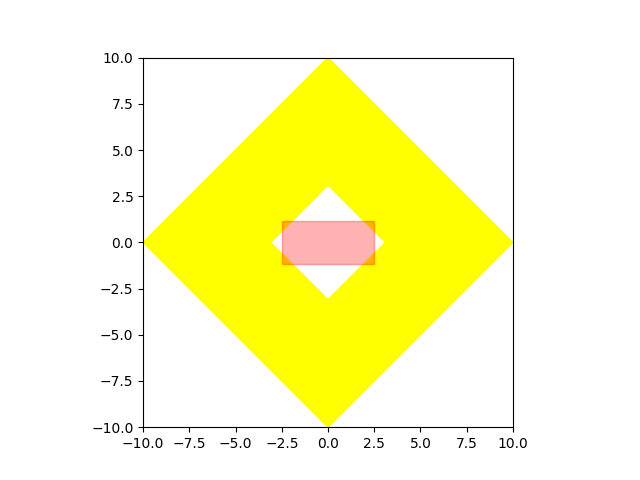
Applying all zero action will cause the state below.
Because the space has a hole on its center, the patch is out of space.
So, it's not vaild and won't make any differences.
state = env.step(0,0,0)
print(state)
env.render()

{
    'is_valid': False,
    'n_steps': 1,
    'n_patches': 0,
    'space': {
        'shell': array([[  0., -10.],
                        [-10.,   0.],
                        [  0.,  10.],
                        [ 10.,   0.],
                        [  0., -10.]]),
        'holes': [
            array([[ 0., -3.],
                    [ 3.,  0.],
                    [ 0.,  3.],
                    [-3.,  0.],
                    [ 0., -3.]])
        ]
    },
    'selected_patch': array([[-2.5 , -1.15],
                            [ 2.5 , -1.15],
                            [ 2.5 ,  1.15],
                            [-2.5 ,  1.15],
                            [-2.5 , -1.15]]),
    'placed_patches': [],
    'area_out_of_space': 10.654999999999998,
    'area_intersect_patches': 0.0
}
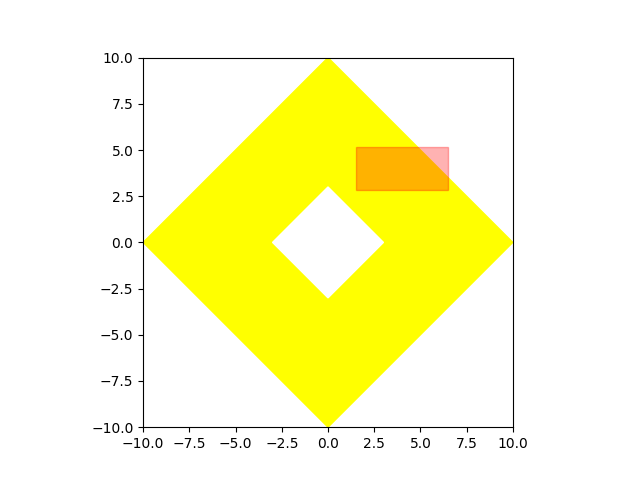
Applying (4,4,0) action will cause the state below.
The patch angle is not proper, and the patch is out of space.
So, it's not vaild and won't make any differences.
state = env.step(4,4,0)
print(state)
env.render()

{
    'is_valid': False,
    'n_steps': 2,
    'n_patches': 0,
    'space': {
        'shell': array([[  0., -10.],
                        [-10.,   0.],
                        [  0.,  10.],
                        [ 10.,   0.],
                        [  0., -10.]]),
        'holes': [
            array([[ 0., -3.],
                    [ 3.,  0.],
                    [ 0.,  3.],
                    [-3.,  0.],
                    [ 0., -3.]])
        ]
    },
    'selected_patch': array([[1.5 , 2.85],
                            [6.5 , 2.85],
                            [6.5 , 5.15],
                            [1.5 , 5.15],
                            [1.5 , 2.85]]),
    'placed_patches': [],
    'area_out_of_space': 1.3612500000000005,
    'area_intersect_patches': 0.0
}
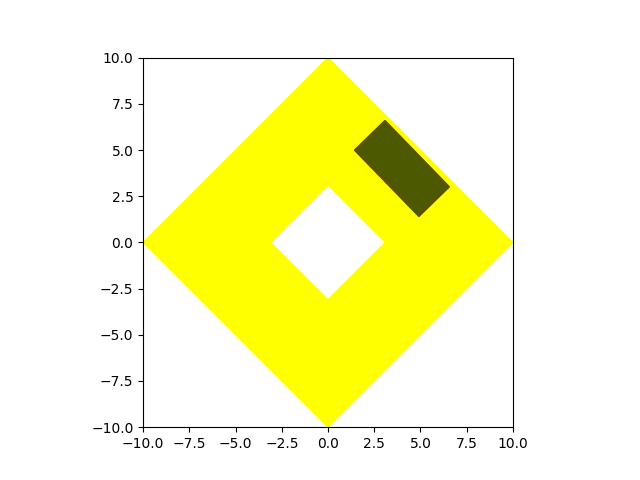
Applying (4,4,-0.8) action will cause the state below.
The patch is within the space, and it's placed.
state = env.step(4,4,-0.8)
print(state)
env.render()

{
    'is_valid': True,
    'n_steps': 3,
    'n_patches': 1,
    'space': {
        'shell': array([[  0., -10.],
                        [-10.,   0.],
                        [  0.,  10.],
                        [ 10.,   0.],
                        [  0., -10.]]),
        'holes': [
            array([[ 0., -3.],
                    [ 3.,  0.],
                    [ 0.,  3.],
                    [-3.,  0.],
                    [ 0., -3.]])
        ]
    },
    'selected_patch': array([[1.43327372, 4.99217751],
                            [4.91680727, 1.40539706],
                            [6.56672628, 3.00782249],
                            [3.08319273, 6.59460294],
                            [1.43327372, 4.99217751]]),
    'placed_patches': [
        array([[1.43327372, 4.99217751],
                [4.91680727, 1.40539706],
                [6.56672628, 3.00782249],
                [3.08319273, 6.59460294],
                [1.43327372, 4.99217751]])
    ],
    'area_out_of_space': 0.0,
    'area_intersect_patches': 0.0
}
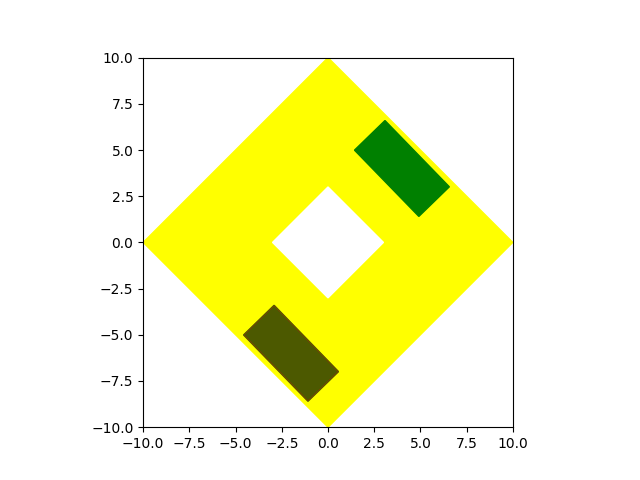
Applying (-2,-6,-0.8) action will cause the state below.
The patch is within the space, and it's placed.
state = env.step(-2,-6,-0.8)
print(state)
env.render()

{
    'is_valid': True,
    'n_steps': 4,
    'n_patches': 2,
    'space': {
        'shell': array([[  0., -10.],
                        [-10.,   0.],
                        [  0.,  10.],
                        [ 10.,   0.],
                        [  0., -10.]]),
        'holes': [
            array([[ 0., -3.],
                    [ 3.,  0.],
                    [ 0.,  3.],
                    [-3.,  0.],
                    [ 0., -3.]])
        ]
    },
    'selected_patch': array([[-4.56672628, -5.00782249],
                            [-1.08319273, -8.59460294],
                            [ 0.56672628, -6.99217751],
                            [-2.91680727, -3.40539706],
                            [-4.56672628, -5.00782249]]),
    'placed_patches': [
        array([[1.43327372, 4.99217751],
                [4.91680727, 1.40539706],
                [6.56672628, 3.00782249],
                [3.08319273, 6.59460294],
                [1.43327372, 4.99217751]]),
        array([[-4.56672628, -5.00782249],
                [-1.08319273, -8.59460294],
                [ 0.56672628, -6.99217751],
                [-2.91680727, -3.40539706],
                [-4.56672628, -5.00782249]])
    ],
    'area_out_of_space': 0.0,
    'area_intersect_patches': 0.0
}
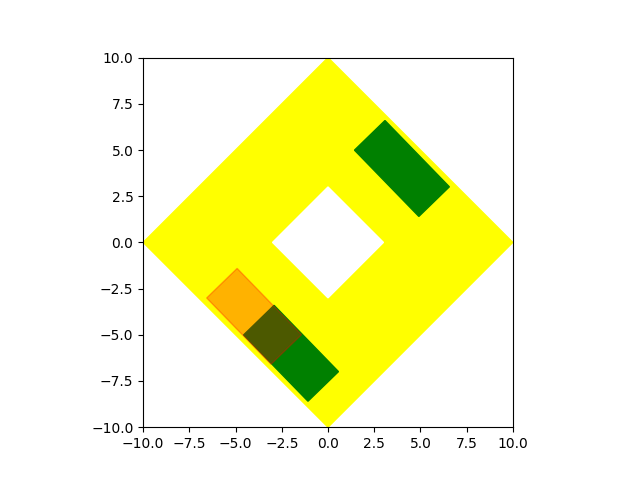
Applying (-4,-4,-0.8) action will cause the state below.
The patch is within the space, but overlap other patch(-2,-6,-0.8 patch).
So, it's not vaild and won't make any differences.
state = env.step(-4,-4,-0.8)
print(state)
env.render()

{
    'is_valid': False,
    'n_steps': 5,
    'n_patches': 2,
    'space': {
        'shell': array([[  0., -10.],
                        [-10.,   0.],
                        [  0.,  10.],
                        [ 10.,   0.],
                        [  0., -10.]]),
        'holes': [
            array([[ 0., -3.],
                    [ 3.,  0.],
                    [ 0.,  3.],
                    [-3.,  0.],
                    [ 0., -3.]])
        ]
    },
    'selected_patch': array([[-6.56672628, -3.00782249],
                            [-3.08319273, -6.59460294],
                            [-1.43327372, -4.99217751],
                            [-4.91680727, -1.40539706],
                            [-6.56672628, -3.00782249]]),
    'placed_patches': [
        array([[1.43327372, 4.99217751],
                [4.91680727, 1.40539706],
                [6.56672628, 3.00782249],
                [3.08319273, 6.59460294],
                [1.43327372, 4.99217751]]),
        array([[-4.56672628, -5.00782249],
                [-1.08319273, -8.59460294],
                [ 0.56672628, -6.99217751],
                [-2.91680727, -3.40539706],
                [-4.56672628, -5.00782249]])
    ],
    'area_out_of_space': 0.0,
    'area_intersect_patches': 4.905615392546818
}
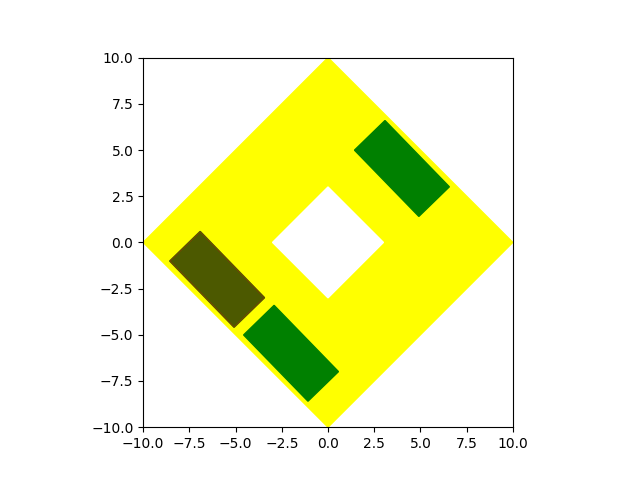
Applying (-6,-2,-0.8) action will cause the state below.
The patch is within the space, and doesn't touch any other patches.
So, it's placed.
state = env.step(-6,-2,-0.8)
print(state)
env.render()

{
    'is_valid': True,
    'n_steps': 6,
    'n_patches': 3,
    'space': {
        'shell': array([[  0., -10.],
                        [-10.,   0.],
                        [  0.,  10.],
                        [ 10.,   0.],
                        [  0., -10.]]),
        'holes': [
            array([[ 0., -3.],
                    [ 3.,  0.],
                    [ 0.,  3.],
                    [-3.,  0.],
                    [ 0., -3.]])
        ]
    },
    'selected_patch': array([[-8.56672628, -1.00782249],
                            [-5.08319273, -4.59460294],
                            [-3.43327372, -2.99217751],
                            [-6.91680727,  0.59460294],
                            [-8.56672628, -1.00782249]]),
    'placed_patches': [
        array([[1.43327372, 4.99217751],
            [4.91680727, 1.40539706],
            [6.56672628, 3.00782249],
            [3.08319273, 6.59460294],
            [1.43327372, 4.99217751]]),
        array([[-4.56672628, -5.00782249],
            [-1.08319273, -8.59460294],
            [ 0.56672628, -6.99217751],
            [-2.91680727, -3.40539706],
            [-4.56672628, -5.00782249]]),
        array([[-8.56672628, -1.00782249],
            [-5.08319273, -4.59460294],
            [-3.43327372, -2.99217751],
            [-6.91680727,  0.59460294],
            [-8.56672628, -1.00782249]])
    ],
    'area_out_of_space': 0.0,
    'area_intersect_patches': 0.0
}
- Applicants are free to set the deadline for submission. However, you must notify us of the deadline in advance.
- Deadline notification due : Until the day after the test notification mail is sent
- Please notify us by e-mail(iglee@spacewalk.tech).
You don't have to rush to submit, so give yourself plenty of time.
Once you fix the deadline, please stick to it.
If you think you will not be able to do it within the deadline, please notify us by e-mail in advance.
-
Answer document
- Answer document should describe in detail how you solved the problem, and why you solved the problem like that.
- There is no restrictions on the format of the document, but the document should be sufficiently expressive of how you solved the problem.
- Please add some images and performance properties of your final results on the document.
- Training graph have to be attached to the document.
- We will find not only your theoretical approach, but also your skills to produce proper training information, and to drive the learning with proper tuning.
-
Agent code
- Agent(Problem solver) code have to be submitted.
- Reproducibility is crucial. If you have additional resources required to reproduce your result, you should include them in your submission (checkpoints, etc.)
(Optional)
- Wrapper environment code
- If you created wrapper environment code, you should include it in your submission.
Reproducibility with minimum effort is the most important for your submission.
You don't have to divide your code into agent part and environment part.
Please attach all things that required for us to reproduce your result.
If we fail to reproduce your result described on answer document, and if there are no valid cause for the non-reproducibility, your score may be deducted.
- Please submit your submission by e-mail(iglee@spacewalk.tech).
- Problem solving process : 25%
- Problem solving process have to be scientific.
- The document should follow your problem solving process.
- Scientific hypothesis : 25%
- It includes the expected characteristic of the problem, and why you choose the method.
- The hypothesis have to be reasonable, and scientific.
- Your hypothesis should be described on the document.
- Phenomenon analysis : 25%
- Once you validate your hypothesis with experiment, you can get the result.
- From result, observe phenomenon and analyze it.
- This analysis have to be described on the document.
- Document & code quality : 10%
- Document and code should be written in a communicative manner.
- Result performance : 15%
- Spacewalk is a performance-oriented company, and we will score result performance as well as problem solving procedure.
- We will retrain your model, and check if the result is same as you described on the document.
- The criteria of result performance are "final performance", "sample efficiency" and "training stability".
from spwkml import PolygonFillEnv
import numpy as np
from shapely import geometry
import cv2


class WrapperEnv():
    """
    Test for ML chapter applicants
    Fill polygon space with polygon patches
    """

    def __init__(self, img_res=128, angle_res=36):
        self.img_res = img_res
        self.angle_res = angle_res
        self.coord_mp = float(self.img_res / 20)
        self.angle_mp = float(self.angle_res / np.pi)
        self.original_env = PolygonFillEnv()
        self.patch_area = geometry.asPolygon(self.original_env.patch).area
        self.reset()

    def reset(self):
        self.original_env.reset()
        self.canvas = np.zeros((self.img_res,self.img_res,3), dtype=np.uint8)
        self.draw(self.original_env.space['shell'], (1,0,0))
        for hole in self.original_env.space['holes']:
            self.draw(hole, (0,0,0))
        return self.canvas.astype(np.bool).astype(np.float32)

    def select_space(self, idx):
        self.original_env.select_space(idx)
        self.reset()

    def draw(self, arr, color, to_canvas=True):
        pts = np.around((arr + 10) * self.coord_mp).astype(np.int32)
        img = cv2.fillPoly(np.zeros(self.canvas.shape, dtype=np.uint8), [pts], color)
        if to_canvas:
            cv2.fillPoly(self.canvas, [pts], color)
        return img

    @property
    def spaces(self):
        return self.original_env.spaces

    @property
    def n_steps(self):
        return self.original_env.n_steps

    @property
    def n_patches(self):
        return self.original_env.n_patches

    @property
    def placed_patches(self):
        return self.original_env.placed_patches

    @property
    def patch(self):
        return self.original_env.patch

    @property
    def space(self):
        return self.original_env.space

    @property
    def new_patch(self):
        return self.original_env.new_patch

    def step(self, action):
        action_x, action_y, action_angle = np.squeeze(action)
        # xy range : 0 ~ 128 (1 bucket added)
        # angle range : 0 ~ 36 (1 bucket added)
        patch_x = float(action_x) / self.coord_mp - 10
        patch_y = float(action_y) / self.coord_mp - 10
        patch_angle = float(action_angle) / self.angle_mp - np.pi/2
        data = self.original_env.step(patch_x, patch_y, patch_angle)
        data['patch_raster'] = self.draw(data['selected_patch'], (0,1,0), to_canvas=data['is_valid']).astype(np.bool).astype(np.float32)
        data['state_raster'] = self.canvas.astype(np.bool).astype(np.float32)

        parking_score = data['n_patches'] / 32 # 0 ~ 1
        area_penalty = -(data['area_out_of_space'] + data['area_intersect_patches']) / self.patch_area # -1 ~ 0

        data['rew'] = parking_score + area_penalty
        data['done'] = not data['is_valid']

        if data['done']:
            self.reset()

        return data

    def render(self, save_img=False, path=None, fname=None, show_last=True, show_axis=True):
self.original_env.render(save_img=save_img, path=path, fname=fname, show_last=show_last, show_axis=show_axis)from env.wrapper_env import WrapperEnv
import numpy as np
import cv2
env = WrapperEnv()
img1 = env.reset()
data = env.step((64,64,18))
print(data['is_valid'])
img2 = data['state_raster']
data = env.step((32,32,9))
print(data['is_valid'])
img3 = data['state_raster']
img1 = img1.astype(np.uint8) * 255
img2 = img2.astype(np.uint8) * 255
img3 = img3.astype(np.uint8) * 255
cv2.imshow('img', img1)
cv2.waitKey(0)
cv2.imshow('img', img2)
cv2.waitKey(0)
cv2.imshow('img', img3)
cv2.waitKey(0)