Inside the container, you find the Whisper original notebooks (LibriSpeech.ipynb, Multilingual_ASR.ipynb) and the extra notebook (record-and-transcribe.ipynb) added by this jetson-containers package under the following directory.
/opt/whisper/notebooks
This container has a default run command that will automatically start the Jupyter by CMD command in Dockerfile like this:
CMD /bin/bash -c "jupyter lab --ip 0.0.0.0 --port 8888  --certfile=mycert.pem --keyfile mykey.key --allow-root &> /var/log/jupyter.log" & \
	echo "allow 10 sec for JupyterLab to start @ https://$(hostname -I | cut -d' ' -f1):8888 (password nvidia)" && \
	echo "JupterLab logging location:  /var/log/jupyter.log  (inside the container)" && \
	/bin/bash
Open your web browser and access http://HOSTNAME:8888.
It is enabling HTTPS (SSL) connection, so you will see a warning message like this.
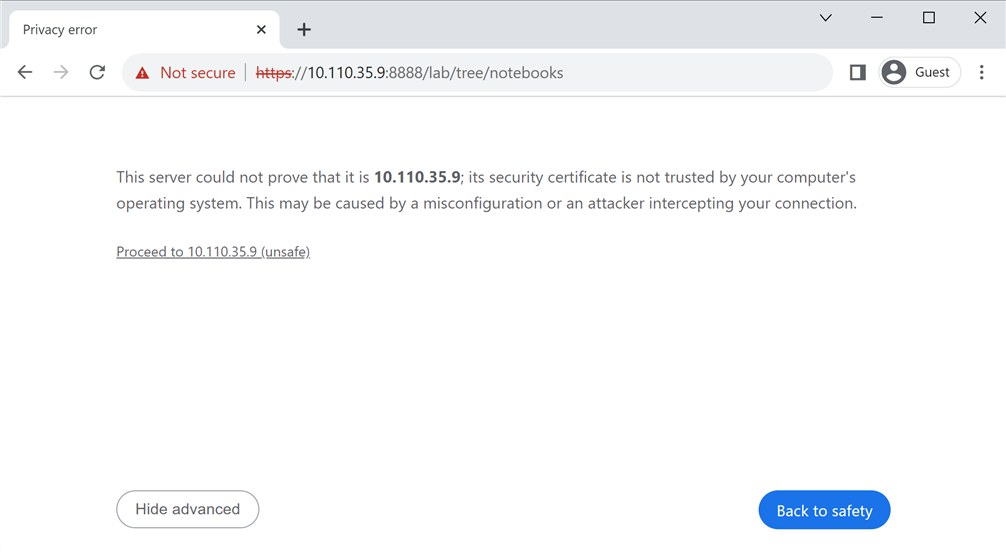
Press "Advanced" button and then press "Proceed to <IP_ADDRESS> (unsafe)" to proceed.
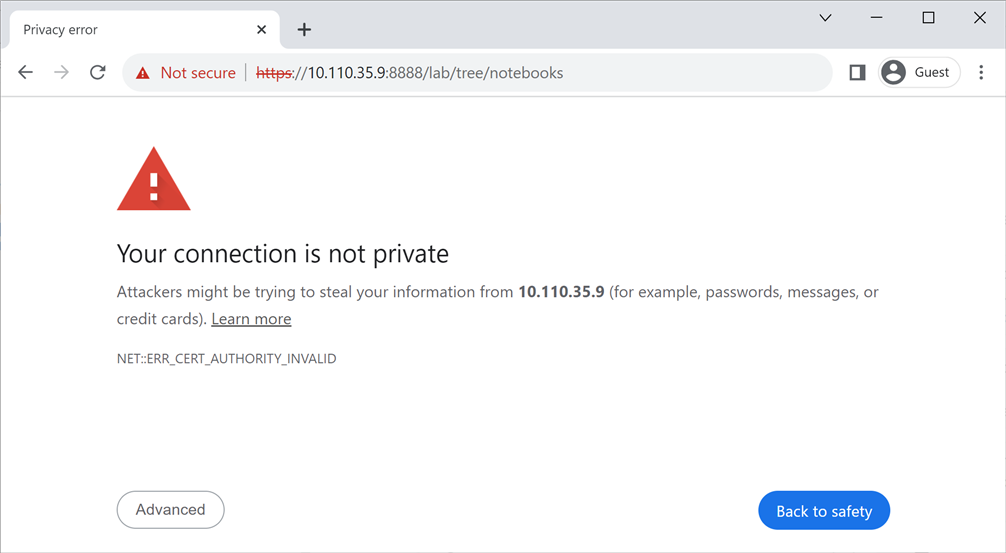
HTTPS (SSL) connection is needed to allow ipywebrtc widget to have access to the microphone (for record-and-transcribe.ipynb).
CONTAINERS
whisper |
|
|---|---|
| Requires | L4T ['>=34.1.0'] |
| Dependencies | build-essential pip_cache:cu126 cuda:12.6 python numpy numba cudnn:9.3 cmake onnx pytorch:2.8 torchaudio tensorrt cuda-python pycuda rust jupyterlab |
| Dependants | voice-pro |
| Dockerfile | Dockerfile |
| Images | dustynv/whisper:r35.3.1 (2024-03-07, 6.0GB)dustynv/whisper:r35.4.1 (2023-12-14, 6.1GB)dustynv/whisper:r36.2.0 (2024-03-03, 7.9GB) |
CONTAINER IMAGES
| Repository/Tag | Date | Arch | Size |
|---|---|---|---|
dustynv/whisper:r35.3.1 |
2024-03-07 |
arm64 |
6.0GB |
dustynv/whisper:r35.4.1 |
2023-12-14 |
arm64 |
6.1GB |
dustynv/whisper:r36.2.0 |
2024-03-03 |
arm64 |
7.9GB |
Container images are compatible with other minor versions of JetPack/L4T:
• L4T R32.7 containers can run on other versions of L4T R32.7 (JetPack 4.6+)
• L4T R35.x containers can run on other versions of L4T R35.x (JetPack 5.1+)
RUN CONTAINER
To start the container, you can use jetson-containers run and autotag, or manually put together a docker run command:
# automatically pull or build a compatible container image
jetson-containers run $(autotag whisper)

# or explicitly specify one of the container images above
jetson-containers run dustynv/whisper:r35.3.1

# or if using 'docker run' (specify image and mounts/ect)
sudo docker run --runtime nvidia -it --rm --network=host dustynv/whisper:r35.3.1
jetson-containers runforwards arguments todocker runwith some defaults added (like--runtime nvidia, mounts a/datacache, and detects devices)
autotagfinds a container image that's compatible with your version of JetPack/L4T - either locally, pulled from a registry, or by building it.
To mount your own directories into the container, use the -v or --volume flags:
jetson-containers run -v /path/on/host:/path/in/container $(autotag whisper)To launch the container running a command, as opposed to an interactive shell:
jetson-containers run $(autotag whisper) my_app --abc xyzYou can pass any options to it that you would to docker run, and it'll print out the full command that it constructs before executing it.
BUILD CONTAINER
If you use autotag as shown above, it'll ask to build the container for you if needed. To manually build it, first do the system setup, then run:
jetson-containers build whisperThe dependencies from above will be built into the container, and it'll be tested during. Run it with --help for build options.